

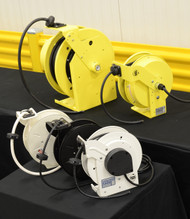
Why Warehouse & Distribution Center Managers Are Switching to Retractable Cord Reels
Floor-run extension cords act as physical liabilities on an active loading dock. When warehouse operations rely on disorganized temporary power, the consequences extend well beyond mere inconvenience. A tripping incident near a pallet rack can lead to immediate lost-time injuries. Poor cord management can create avoidable safety and operational challenges in busy facilities.
Facility managers and safety officers recognize a harsh reality: mismanaging temporary power access exacts a heavy toll in downtime, mandatory audits, and safety liabilities.
For over 65 years, KH Industries has defined American manufacturing authority within the field of industrial power products. We engineer robust solutions designed to withstand harsh environments. Through our New York manufacturing facility, our deep vertical integration, including in-house CNC machining, molding, and metal stamping, helps mitigate supply chain risks while supporting third-party verifiable compliance. This guide details exactly how operations managers are replacing floor cords with structured, retractable power solutions to help protect personnel and the bottom line.
Why Warehouse Power Access Is a Bigger Operational Problem Than Most DCs Realize
Open a high-volume distribution center and look at the floor. Extension cables snake across active forklift paths, drape over pallet racks, and pool around charging stations. This is the operational pain point that Retractable Extension Cord Reels are designed to address.
Operations Managers, EHS Directors, and Facility Engineers face a daily battle against power access inefficiencies. The primary issue is not a lack of outlets. It is the chaos of unmanaged power distribution. When floor teams waste fifteen minutes per shift wrestling tangled extension cords, productivity drops. When dock operations halt during shift changes because a vital power line sustains damage, the financial impact begins.
The Real Cost of Poor Cord Management in Warehouses and Distribution Centers
Poor cord management acts as an active drain on a facility's Total Cost of Ownership (TCO). Operations must account for several specific financial burdens:
- Forklift and Pallet Jack Damage: Floor-run cords in active zones inevitably sustain impact. A 9,000-pound forklift crushing a standard cord destroys the insulation, which can short out connected equipment. Operations pay for the replacement cord, the damaged tool, and the resulting downtime.
- Worker Time Lost: Manual cord handling proves notoriously inefficient. Winding, unwinding, and untangling cords consumes critical man-hours per shift.
- Insurance and Liability Exposure: Trip-and-fall incidents rank among the leading causes of workers' compensation claims in industrial settings. Unmanaged cords elevate this risk, which can drive up insurance premiums and liability exposure.
Read More Cord Reel Mistakes That Cost Industrial Facilities Money - And How to Avoid Them
OSHA Compliance and Temporary Power in Warehouse Environments
The Occupational Safety and Health Administration (OSHA) scrutinizes temporary wiring solutions. Floor-run cords in active forklift zones often directly violate OSHA standards.
- OSHA 1910.303: Requires electrical equipment to be free from recognized hazards likely to cause death or serious physical harm.
- OSHA 1910.305: Governs temporary wiring, explicitly demanding cord protection, proper grounding, and prohibiting cords from running through doorways or areas where they might sustain damage.
Floor-run cords in active forklift zones can put a facility out of step with OSHA workplace safety standards governing flexible cords and temporary wiring. These standards address the protection of electrical equipment from recognized hazards, and they restrict how flexible cords are routed, grounded, and protected from damage.
Read More OSHA Extension Cord Standards Industrial Facilities Must Follow
Retractable cord reels are commonly used to help improve cable organization and workplace safety. By lifting cords off the floor and out of transit paths, ceiling-mounted or wall-mounted reels help mitigate the trip hazards and physical damage risks that trigger OSHA citations. EHS managers actively seek out overhead retractable solutions to meet NEC temporary power requirements.
Need help speccing cord reels for OSHA compliance in a facility? Talk to an Expert on our engineering team.
What Makes a Cord Reel 'Industrial-Grade' for Warehouse Use?
Buyers must recognize that not all reels are created equal. Commercial-grade cord reels may wear out faster in high-cycle industrial environments. Buyers need to understand the specifications they are sourcing.
Commercial-grade reels rely on plastic housings, light-duty springs, and standard slip rings that can overheat under continuous loads. True industrial-grade reels feature all-steel construction, deep-drawn housings, and heavy-duty SOOW or SJOW cable jackets designed to resist oil, water, and severe abrasion.
Duty cycle remains a critical differentiator. While a consumer reel might deploy twice a week, a warehouse reel retracts hundreds of times per shift.
Industrial settings also demand specific environmental protections, ranging from NEMA 2 for standard indoor warehouses to NEMA 4X for washdown or cold storage environments. Our cord reel platforms span NEMA 2, 4, and 4X ratings, from 15A light-industrial to 50A heavy-duty builds. Integrating Heavy Duty Retractable Cord Reels is a practical long-term solution.
Read More Benefits of Upgrading to a Heavy-Duty Industrial Cord Reel
Technical Comparison: Industrial vs. Commercial Duty
| Specification | Light-Duty / Commercial Reel | KH Industries Heavy-Duty Reel |
|---|---|---|
| Housing Construction | High-impact plastic or thin aluminum | Heavy-duty, all-steel construction with powder-coat finish |
| Cable Jacket | SJT (Light-duty vinyl) | SOOW / SJOOW (Oil, water, weather, and abrasion resistant) |
| Slip Ring Assembly | 15 Amp maximum | 20-30 Amp continuous duty, high-conductivity modular slip rings |
| Enclosure Rating | NEMA 1 (Basic indoor) | Up to NEMA 4X (Watertight, corrosion-resistant) |
| Spring Mechanism | Exposed, light-tension | Enclosed, factory-lubricated mainspring |
Key Spec Dimensions to Define Before Purchasing
Before contacting a supplier, sourcing teams must define the exact technical requirements of the work zone. Use the following criteria to establish precise specifications:
- Voltage and Amperage Requirement: Know the exact electrical draw of the powered equipment.
- Cable Length: Calculate the total reach needed for the specific work zone.
- Mounting Surface: Determine the structural requirement for ceiling, wall, column, or boom mounting.
- Environmental Conditions: Identify if the area involves cold storage, excessive dust, or caustic washdowns.
- Duty Cycle: Estimate the active usage hours per day.
- Connector Type: Specify whether the application requires a single receptacle, a quad box, or a specialized twist-lock connector.
- NEMA Enclosure Requirement: Match the reel's rating to the environmental hazard level.
6 Ways Retractable Cord Reels Improve Warehouse & Distribution Centers Operations
Transitioning to retractable power transforms daily operations across multiple measurable metrics. Each benefit below ties directly to a specific operational priority.
- OSHA and Safety Compliance: For EHS Directors, the primary victory is risk abatement. Retractable reels help mitigate floor-cord violations, reducing trip hazards and supporting facility compliance with OSHA regulations.
- Forklift Aisle Clearance: Operations Managers demand fluidity. Retracting power lines to the ceiling helps prevent cord-related forklift incidents. Operators navigate aisles safely, which reduces equipment damage.
- Shift Changeover Speed: Time dictates efficiency on the floor. With retractable units, workers spend less time managing cords, allowing faster setup and teardown during shift transitions.
- Floor Space Utilization: Facility Directors require optimized square footage. Ceiling and wall-mounted reels free up real estate in dock and pick/pack zones.
- Cable Longevity: Maintenance Directors track replacement costs closely. Retractable internal mechanisms prevent kinking and physical crushing, extending the operational lifespan of the cable.
- Multi-Zone Power Flexibility: Distribution center layouts evolve. DC Engineers utilize strategically placed reels to serve changing configurations without incurring the cost of hard-rewiring the facility.
Warehouse Use Cases: Where Retractable Cord Reels And Industrial Power Products Are Most Valuable
Retractable power serves distinct functions across a logistics facility. Different zones require precise power access strategies.
- Dock Doors & Loading Bays: When shift changes overlap with heavy incoming freight, forklift operators must avoid live cables powering dock levelers, chargers, or handheld scanners. Using Indoor Industrial Cord Reels lifts the hazard upward, keeping concrete floors clear.
- Pick & Pack Stations: Agility on the fulfillment floor halts if a picker trips over an extension cord. Overhead reels provide flexible power drops directly to mobile workstations without creating floor hazards.
- Battery Charging Stations: Cables pooling on the concrete near forklift and AGV chargers risk being crushed under heavy machinery. Heavy-duty reels organize these critical lines to protect expensive connectors.
- Cross-Dock Operations: Transit zones demand low friction. Temporary power in high-traffic cross-dock areas must deploy quickly and retract immediately to maintain clear paths. Utilizing Portable Outlet Boxes in conjunction with retractable drops supports rapid freight processing.
- Cold Storage & Refrigerated DCs: Sub-zero temperatures can shatter commercial-grade plastics. Integrating NEMA 4X cord reel power stations provides the watertight, all-steel integrity required to survive freezing, washdown-rated environments without triggering electrical faults.
- Mezzanine & Elevated Work Areas: Running hard conduit along elevated catwalks represents a significant capital expense. Ceiling-drop cord access delivers compliant power directly to overhead zones where maintenance crews operate.
Retractable Cord Reels for Specific Warehouse Industry Verticals
Different industries subject electrical infrastructure to unique operational limits.
- E-commerce Fulfillment: High throughput and rapid layout changes define this sector. Fulfillment centers utilize reels to establish multiple workstation zones that can undergo swift reconfiguration.
- 3PL (Third-Party Logistics): Multi-client bays demand versatile power. 3PL providers rely on retractable units to support flexible power zones across diverse client requirements.
- Food and Beverage Distribution: Facilities must adhere to washdown and hygiene compliance protocols. Only NEMA 4X cold storage-rated reels can endure high-pressure cleaning while maintaining electrical safety.
- Automotive Parts Distribution: Managing heavy-duty power for pneumatic tools and charging bays requires severe-duty equipment with continuous-duty slip rings and abrasion-resistant cable jackets.
- Retail DC Operations: Fast seasonal reconfigurations require power solutions that support rapid transitions from dock-to-shelf operations. We engineer equipment tailored directly for Commercial & Retail Logistics environments.
Read More 5 Custom Cord Reel Configurations KH Has Built for Hard-to-Solve Environments
What to Look for When Choosing a Cord Reel Supplier for Your Warehouse
Buyers must look beyond the initial price tag. Evaluating a vendor requires an assessment of its engineering capabilities. Industrial buyers should apply these five criteria:
- Industrial vs. Commercial Duty Cycle Rating: Does the manufacturer build for heavy industry? Look for robust all-steel construction capable of handling rigorous deployment schedules.
- NEMA Enclosure Options: The physical environment dictates the enclosure rating. A capable supplier provides standard NEMA 2 indoor models as well as specialized NEMA 4X units. If exterior operations are involved, verify they supply true Outdoor Industrial Cord Reels.
- U.S. Manufacturing: Localized production supports reliable lead times and consistent parts availability. We maintain deep vertical integration in New York to keep project timelines on schedule.
- UL/ETL Listing: Third-party verification remains vital for insurance liability and AHJ compliance. Components must carry certified UL or CSA marks.
- Engineering Support: Specialized warehouse applications may require cord reels with specific cable lengths, mounting configurations, guide arm positions, or plug and receptacle combinations. Facility owners benefit from suppliers that offer engineering support to help match retractable cord reels to loading docks, maintenance areas, packing stations, and other facility requirements.
KH Industries aligns with each of these criteria, supplying built-to-spec industrial solutions backed by dedicated engineering support. For teams weighing sourcing routes, our guide on buying industrial cord reels direct from the manufacturer versus through a distributor covers how each affects lead time and support.
Read More Do Electrical Product Certifications Matter? What Every Industrial Buyer Must Know
Retractable Cord Reels Are an Operational Investment, Not a Line Item
Treating cord management as a secondary maintenance expense is a miscalculation. Retractable cord reels represent a definitive operational investment. When facilities weigh the total cost of unmanaged temporary power, including potential OSHA fines, equipment downtime, cord replacement, forklift damage, and injury liability, the ROI of properly specified retractable reels becomes evident.
We manufacture industrial-grade products directly in the U.S. This localized control means equipment deliveries are not delayed by offshore shipping issues.
Furthermore, operations teams can get a custom quote and receive direct support from an engineering staff ready to specify the exact cable gauge, slip ring, and mounting configuration a facility demands. Proper power distribution helps protect the workforce and the machinery.


