

OSHA Standards for Industrial Facilities: What Compliant Cord Management Looks Like
Industrial facilities often review temporary power setups to improve workplace safety and equipment organization. Improper wiring methods expose operations to downtime, safety liabilities, and operational disruptions. Unspooled cables left across active floors can create safety and maintenance concerns. A production line that halts because of a severed cable carries an immediate cost to the bottom line.
Environmental Health and Safety (EHS) Managers, Safety Directors, and Facility Managers are directly responsible for OSHA compliance. We engineer industrial power products at our New York facility to mitigate these exact citations. Through in-house CNC machining, molding, and metal stamping, we reduce supply chain vulnerabilities and support rugged, US-made reliability.
This guide details exactly what the standards require, where facilities most commonly fail inspections, and what compliant cord management equipment looks like.
Which OSHA Standards Apply to Extension Cords in Industrial Facilities?
Before addressing violations, facilities must know which standard applies to their specific operation. The regulatory framework is divided into General Industry and Construction directives.
| OSHA Standard | Application | Core Mandate | Common Citation Trigger |
|---|---|---|---|
| OSHA 1910.303 | General Industry | Electrical equipment must be approved, listed, and labeled by a NRTL (UL/ETL) | Deploying unlisted components or equipment lacking adequate working space. |
| OSHA 1910.305 | General Industry | Governs exactly when and how flexible cords can be used. | Using cords as permanent wiring substitutes or running them through walls and doorways. |
| OSHA 1926.405 | Construction | Dictates temporary wiring requirements on job sites, including ampacity ratings. | Failing to implement mandatory GFCI protection on temporary receptacle outlets. |
Common OSHA Extension Cord Violations in Industrial Facilities
Compliance audits uncover the same recurring errors. Safety officers look for failure points that may expose operations to fines. Here is what inspectors target and how to fix it:
- Using cords as permanent wiring substitutes: This remains the most common violation under 1910.305(g)(1)(iv). Maintenance teams often string cords along I-beams. The compliant fix involves deploying a retractable cord reel as an approved temporary power solution.
- Floor-run cords in forklift/pedestrian traffic zones: Under 1910.305(a)(2)(x), flexible cords must be protected from accidental damage, and unprotected cables on the floor create severe trip hazards. A ceiling or wall-mounted cord reel keeps the cord elevated off the floor.
- Damaged or spliced cords in service: Taped electrical cords violate 1910.305(g)(2)(ii). Operations must establish an inspection schedule and mandate the immediate removal of damaged cords.
- Missing or damaged strain relief at connection points: Pulling a plug by the cable tears the wiring, violating 1910.305(g)(2)(iii). Facilities must specify cord reels engineered with proper strain relief at the outlet.
- Overloaded or undersized cords for the load: Connecting heavy-draw equipment to light-duty cable conflicts with the requirement that flexible cords be approved for their conditions of use (1910.305(g)(1)(i)), with ampacity governed by the applicable NEC limits. Facility teams must match the American Wire Gauge (AWG) to the actual running load rather than the nameplate.
- Cords run through walls, ceilings, or doorways: Routing temporary power through structural boundaries violates 1910.305(g)(1)(iv)(B). Power should be routed from a mounted reel overhead, avoiding building structures.
- Missing grounding in environments requiring it: Using ungrounded equipment in wet or conductive areas creates shock hazards. Grounding-type equipment must use a flexible cord with an equipment grounding conductor (1910.334(a)(3)), and equipment in wet or conductive locations must be approved for those locations (1910.334(a)(4)). Implementing a grounded cord reel in static-sensitive or wet environments helps maintain safety.
Read More Benefits of Upgrading to a Heavy-Duty Industrial Cord Reel
What OSHA-Compliant Cord Management Actually Looks Like in Practice
Passing an electrical safety audit requires translating regulatory text into operational reality. It means deploying equipment that natively addresses compliance criteria across manufacturing floors, warehouses, construction sites, and shipbuilding facilities.
How Retractable Cord Reels Address OSHA 1910.305 Requirements
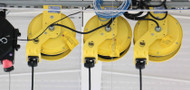
A properly specified Retractable Extension Cord Reels maps directly to regulatory mandates:
- Floor Clearances: The retractable mechanism keeps the cord off the floor, which directly addresses the 1910.305(g)(1)(iv) floor-run prohibition.
- Mechanical Integrity: Engineered cord grips at the payout outlet satisfy the 1910.305(g)(2)(iii) strain relief requirement.
- Approved Equipment: Utilizing products that carry a valid UL/ETL listing satisfies the 1910.303(b)(1) approved equipment mandate.
- Physical Protection: Heavy-duty NEMA enclosures protect the stored cord from crushing forces, damage, and moisture per 1910.305(a)(2).
When a Retractable Cord Reel Is Not Enough: What Else OSHA Requires
While industrial cord reels provide the necessary physical infrastructure, compliance remains a system-wide effort. Facilities must enforce procedural standards:
- GFCI Protection: Facilities must implement GFCI protection per 1910.304(b)(3) for any damp locations.
- Lockout/Tagout (LOTO): Where cord-connected equipment is serviced, lockout/tagout procedures must be enforced under OSHA 1910.147.
- Inspection Records: OSHA requires rigorous cord inspection records and documentation under 1910.334(a)(2).
Evaluating temporary power management in a facility? Call KH Industries at 716-312-0088.
OSHA Extension Cord Compliance by Industry Vertical
Every industrial sector faces operational contexts that dictate regulatory focus points.
| Industry Vertical | Primary OSHA Standard | Operational Context & Hazards | Recommended Infrastructure |
|---|---|---|---|
| Manufacturing | 1910.303 / 1910.305 | Continuous-duty temporary power in active forklift zones; machine tool connections | Heavy Duty Industrial Cord Reels |
| Warehousing & Distribution | 1910.305 | Important floor cord prohibitions, dock door power access, and battery charging station compliance. | Indoor Industrial Cord Reels for overhead access. |
| Construction | 1926.405 | Multi-contractor environments requiring mandatory GFCI and rugged jobsite temporary power. | outdoor industrial cord reels with GFCI drops. |
| Naval / Shipbuilding | NEC 553 / OSHA wet and conductive location requirements (1910.334(a)(4)) | Confined space cord requirements and damp/wet location ratings in salt-spray environments. | NEMA 4X push button pendant stations |
| Mining & Energy | 30 CFR / HazLoc Requirements | Class I, Division 1/2 classified areas requiring spark-mitigation and explosion-proof ratings. | Hazardous Location Explosion-Proof Cord Reels |
Read More Why Warehouse & Distribution Center Managers Are Switching to Retractable Cord Reels
OSHA Extension Cord Inspection and Maintenance Requirements
Compliance does not end with procurement. Operations must document, inspect, and maintain the equipment. OSHA 1910.334(a)(2) mandates pre-use protocols.
- Before-Use Inspection Requirement: Equipment must be visually inspected before each use. For continuous-duty applications in high-use industrial environments, this standard translates to an inspection before each shift.
- What Inspectors Look For: Maintenance teams must check for jacket damage, including cuts, abrasions, and brittleness. They must also verify connector integrity, the condition of the grounding pin, and strain relief integrity.
- Removal from Service: Any visible damage requires the immediate removal of the cord from service and proper tag-out.
- Record-Keeping: On construction sites, the Assured Equipment Grounding Conductor Program requires documented cord inspections and test records (1926.404(b)(1)). General-industry facilities are not required to keep these records, though many maintain inspection logs as a best practice.
OSHA Extension Cord Compliance Checklist Quick Reference
This structured reference table is designed for facility walkthroughs and safety audits. It covers all major requirements.
| Requirement | OSHA Standard | Compliant Practice |
|---|---|---|
| Equipment Listing | 1910.303(b)(1) | Procure only NRTL (UL/ETL) listed equipment. |
| Floor Clearances | 1910.303(b) | Mount All Industrial Retractable Cord Reels to reduce trip hazards. |
| Proper Usage | 1910.305(g)(1)(iv) | Do not use cords as permanent wiring or route through walls. |
| Strain Relief | 1910.305(g)(2)(iii) | Specify heavy-duty plugs with engineered cord grips. |
| Physical Damage | 1910.305(a)(2) | Use all-steel reel housings in heavy-traffic zones. |
| Ampacity Rating | 1910.305(g)(1)(i) and applicable NEC ampacity | Match wire gauge (AWG) to peak current draw. |
| Grounding | 1910.334(a)(3) | Discard plugs with missing ground pins immediately. |
| Pre-Use Inspection | 1910.334(a)(2) | Implement visual checks before each shift. |
| Construction GFCI | 1926.405 / 1926.404(b) | Use an integrated GFCI for temporary power. |
| Utility Consolidation | 1910.303(b) | Deploy Cord Reel Power Stations to organize drops. |
See the KH Industries Documents & Manuals library for product specifications and compliance documentation.
OSHA Compliance Is a System Decision, Not a Product Decision
Passing an OSHA inspection requires more than purchasing a single compliant product; it demands deploying a cord management system that addresses the operational conditions creating the violations. The seven most common violations are addressable through the right combination of properly engineered equipment, rigorous inspection practices, and a knowledgeable sourcing partner.
For over 65 years, KH Industries has maintained U.S. manufacturing capabilities to produce equipment designed to meet industrial standards. When standard configurations do not match a facility's footprint, talk to a KH Industries expert to review the operating environment, or request a quote to spec compliant infrastructure for the facility.


