
NEMA 4X: Why Standard Enclosure Ratings Fail in Corrosive Industrial Environments
Specifying the wrong enclosure rating for a corrosive environment can lead to equipment failure and electrical hazards. An industrial maintenance supervisor facing a tripped breaker due to moisture ingress isn't dealing with a product flaw; they are dealing with a specification failure.
According to OSHA regulations 1910.303 regarding general electrical requirements, equipment must be installed and used in accordance with its instructions and ratings. When standard-rated enclosures are deployed into corrosive zones, the operational risk compounds daily.
This article establishes exactly what NEMA 4X means within the NEMA 250 standard, how it differs technically from the NEMA 1, 3R, 4, and 12 ratings, where it is mandated by regulations or environments, and how to specify it correctly for a facility
For operations involving demanding requirements such as washdown areas, or marine environments, KH Industries engineers robust solutions. The vertically integrated facility produces industrial power products engineered for actual industrial survival. From outdoor industrial cord reels built for the elements to sealed washdown-duty cord reels and rugged NEMA 4X push button pendant stations, KH builds the power distribution chain to match the severity of any environment.
What the NEMA Enclosure Rating System Actually Means
The National Electrical Manufacturers Association (NEMA) established the NEMA 250 standard to define the performance parameters of electrical enclosures in specific environments.
The rating system does not simply measure water tightness. It rigorously tests for protection against solid ingress (dust, flying debris), liquid ingress (rain, splashing, heavy hose-downs), corrosion, and even suitability for hazardous locations.
Many buyers conflate NEMA ratings with the IP system (IEC 60529). They aren't interchangeable. NEMA ratings test for significantly more environmental conditions, including ice formation, gasket performance, and corrosion, than the IP system measures.
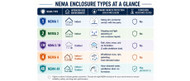
NEMA 1, 3R, 4, and 12: What Standard Ratings Actually Protect Against
Before evaluating 4X, it is important to understand the limitations of standard industrial ratings:
| NEMA Type | Intended Use Environment | Primary Ingress Protection (Solid and Liquid) | Corrosion Resistance Tested |
|---|---|---|---|
| NEMA 1 | Indoor | Falling dirt, incidental contact with live parts. | No |
| NEMA 2 | Indoor | Dripping and light splashing of non-corrosive liquids. | No |
| NEMA 3 / 3R | Outdoor | Rain, sleet, snow, and ice formation. (3 adds windblown dust). | No |
| NEMA 4 | Indoor / Outdoor | Windblown dust, rain, splashing, hose-directed water. | No |
| NEMA 4X | Indoor / Outdoor | Hose-directed water, windblown dust, ice formation. | Yes (ASTM B117) |
NEMA 4 does not equal NEMA 4X. Confusing these two is the single most common and costly specification error in industrial procurement.
Do not force standard industrial ratings into harsh environments. Evaluate the chemical, moisture, and particulate profile of the work cell, and upgrade the specification if washdown protocols or corrosive vapors are present.
KH doesn't recommend standard industrial power products for environments where they aren't rated to survive. With over 65 years of continuous American manufacturing, the KH engineering team audits the operational realities before approving a specification.
Read more: How to Spec and Size an Industrial Cord Reel covers how to match enclosure rating to environment as part of the full specification workflow.
NEMA 4X: The Full Technical Specification
A NEMA 4X rating is the highest level of non-hazardous protection commonly specified in the chemical, food processing, and marine sectors. To achieve a 4X rating per NEMA 250, an enclosure must meet all the requirements of NEMA 4 but with an added layer of mandated corrosion resistance.
The Core Requirements of NEMA 4X:
- Ingress Protection: Must survive a hose-down test where a 1-inch nozzle delivers 65 gallons of water per minute from a distance of 10 feet for at least five minutes. The internal enclosure must remain dry.
- Corrosion Resistance (The ‘X’ Factor): The enclosure must pass the ASTM B117 salt spray test. This involves 200+ hours of continuous exposure to a 5% salt solution without showing signs of corrosion that could compromise the protection of internal components.
- Material Integrity: To meet these requirements, manufacturers use materials like 304 or 316 stainless steel, fiberglass/GRP, or engineered high-performance thermoplastics (polycarbonate/polyester).
NEMA 4 vs. NEMA 4X: The Specification Difference That Costs Facilities
Consider a real-world scenario: A wastewater treatment plant installs a NEMA 4 (not 4X) rated enclosure in a chlorine-atmosphere dosing area. Because NEMA 4 enclosures offer no chemical corrosion resistance, the facility experiences corrosion-induced electrical failure within 18 months.
| Specification | NEMA 4 | NEMA 4X |
|---|---|---|
| Water Ingress Protection | Watertight (Hose-directed) | Watertight (Hose-directed) |
| Corrosion Resistance | None certified | ASTM B117 tested and certified |
| Typical Materials | Painted Carbon Steel | 316 Stainless Steel, Fiberglass, Polycarbonate |
| Salt Spray Test | Not Required | Required (200+ hours) |
| Initial Cost Profile | Standard industrial baseline | Typically, a 30-50% premium (offset by lifespan) |
Avoid the mistake: Specify NEMA 4X explicitly upfront.
NEMA 4X vs. IP66/IP67: Understanding Both Standards
NEMA and IP ratings measure overlapping but different things. IP ratings, defined under IEC 60529, measure ingress protection against dust and liquids only. NEMA ratings cover ingress protection plus broader environmental factors like corrosion resistance, ice formation, and suitability for explosive atmospheres. NEMA is the predominant standard in North America, while IP is the international equivalent used globally.
Because NEMA evaluates additional environmental stressors, a NEMA rating can meet or exceed an IP rating in many cases. The reverse is not true: a standalone IP rating cannot be converted into a NEMA equivalent without additional testing.
This distinction matters when comparing NEMA 4X to IP66 or IP67, ratings often presented as interchangeable. They are not. While NEMA 4X is roughly comparable to IP66 for liquid and dust ingress, IEC 60529 does not test for corrosion resistance or gasket seal performance under temperature cycling. An enclosure can be rated IP66 and still corrode in a marine environment. Domestic US projects typically specify NEMA 4X; international projects may specify ATEX along with IP66 or IP67. An IP66 datasheet claim should not be assumed to equate to NEMA 4X compliance without verification.
Why Standard Enclosure Ratings Fail in Corrosive Industrial Environments
Corrosion costs the US industry approximately $276 billion annually, according to the AMPP (formerly NACE International) IMPACT study. A preventable subset of this heavy financial loss comes from equipment failure directly linked to underrated electrical enclosures.
Standard powder-coated steel enclosures (NEMA 1, 3R, 4, 12) have a fundamental vulnerability. Once the surface coating is scratched, breached, or microscopically compromised by chemical vapors, oxidation accelerates. Internal components, such as breakers, terminal blocks, and slip rings, are quickly exposed to the corrosive atmosphere, leading to arcing, short circuits, and equipment failure.
Operations must transition away from standard metals in these zones. Investing the upfront CapEx increase for NEMA 4X ratings ends the cycle of premature failure, repeat purchase orders, and catastrophic downtime.
Read more: Retrofitting vs. Replacing: When Can You Upgrade an Existing Cord Reel? covers what to do when corrosion has already compromised a reel's housing and internals.
Environments and Industries Where NEMA 4X is Mandatory
Attempting to run standard NEMA 4 equipment in regulated industries creates continuous, unacceptable safety risks that threaten the entire operation.
Specific industries carry operational and regulatory requirements that render standard enclosures a liability:
- Food and Beverage Processing: Facilities governed by FDA 21 CFR, USDA/FSIS, and FSMA washdown protocols face demanding sanitation conditions. Sanitation crews use high-pressure, high-temperature water mixed with caustic and acidic sanitizers like peracetic acid and sodium hypochlorite. These chemicals can strip paint and corrode standard metals over time. NEMA 4X is commonly specified for electrical housings in these zones, though some applications may also call for hazardous location ratings depending on the specific environment.
- Wastewater Treatment Plants: Pump stations, headworks, and clarification zones involve continuous moisture and concentrated H2S (hydrogen sulfide) atmospheres. Hydrogen sulfide is highly corrosive to copper and standard steel. Standard NEMA 4 enclosures may degrade in these conditions, which can contribute to control failures over time. NEMA 4X or higher-rated configurations are typically specified for these environments.
- Chemical Manufacturing: Exposure to chlorine, ammonia, and acid vapors implicates OSHA PSM (Process Safety Management) 1910.119 regulations. Maintaining electrical system integrity in these zones calls for enclosures with strong chemical resistance over time. NEMA 4X is commonly specified, and some applications may also require hazardous location ratings depending on the vapor classification.
- Marine and Naval Shipbuilding: Corrosion from salt air, sea spray, and UV exposure creates demanding conditions for electrical equipment. Standard steel brackets and housings can experience galvanic corrosion in shipyard or onboard environments. NEMA 4X steel or engineered polymers are typically specified for marine deployments, with some applications calling for higher-tier ratings.
- Oil and Gas Offshore: Platforms operate in saline environments with continuous humidity and significant temperature fluctuations. Electrical housing degradation in offshore environments raises significant safety and reliability concerns. NEMA 4X is a common baseline, and most offshore applications require hazardous location ratings under NEC Article 500 as well.
- Pulp and Paper Mills: Highly corrosive chemical processes like the Kraft process, combined with continuous high-pressure steam, call for specialized enclosure ratings to protect power distribution systems. NEMA 4X stainless steel or engineered polymer enclosures are commonly specified, with material selection driven by the specific chemistry of the process.
NEMA 4X Cord Reels and Power Products: Why the Housing Rating Matters for the Full System
A facility engineer specifies an expensive NEMA 4X stainless steel control panel to withstand a washdown environment, but procures standard, NEMA 1-rated retractable extension cord reels to hang next to it. Within months, the cord reels seize, short out, and fail.
The enclosure on a main control panel is not the only component that requires a 4X rating; every electrical component in that corrosive environment does. Mismatched ratings across the power distribution chain cause harm to system integrity. Buying the wrong rating for peripheral equipment leads to mismatched spares, repeated purchase orders, and inconsistent facility standards.
Standardize ratings across the entire electrical layout. If the environment dictates a NEMA 4X panel, the associated cord reels, pendant stations, and outlet boxes must also carry that rating.
KH Industries manufactures Retractable Extension Cord Reels and power distribution products explicitly configured for washdown, chemical, and marine environments.
Read more: Pre-Commissioning Checklist: 7 Things to Inspect Before Powering Up Your New Reel includes verifying the enclosure rating matches the environment before startup.
How to Specify NEMA 4X Products: A Procurement Checklist
Vague RFQs that ask for 'waterproof' or 'IP66 equivalent' equipment result in vendors supplying offshore catalog products with gasket materials not rated for PAA or chlorine exposure.
A rigorous specification process prevents field failures. Procurement engineers should follow this checklist when evaluating vendors for corrosive environments:
- Confirm the Environment Classification: Document the washdown frequency, chemical exposure type, and potential salt/marine exposure.
- Verify NEMA 250 Compliance: Reject simple 'IP66 equivalency' claims. Look for the NEMA 4X designation.
- Specify Housing Material: Confirm the housing material is rated for the application's chemistry profile and validated to applicable corrosion standards (e.g., ASTM B117 salt spray testing)
- Check Seal Compatibility: Verify that the gasket and seal materials are chemically compatible with the specific sanitizers or vapors present in the facility.
- Verify the UL Listing: Ensure the product is UL listed at the NEMA 4X rating, not just baseline electrical safety, also read about Do Electrical Product Certifications Matter? What Every Industrial Buyer Must Know explains how to verify UL and other certification claims.
- Match Downstream Components: Ensure all connected cord reels, pendants, and connectors carry matching ratings.
- Demand Documentation: Confirm the manufacturer can provide certification documentation, not just a marketing datasheet claim.
These seven points lock procurement specs tight enough to refuse vendor bids that don't document ASTM B117 salt spray survival.
Read more: Questions to Ask Your Industrial Cord Reel Manufacturer Before Placing a Bulk Custom Order covers how to structure specs and vet manufacturers before a large purchase.
NEMA 4X vs. Hazardous Location Ratings: Understanding the Overlap
Buyers routinely confuse environmental enclosure ratings (NEMA 4X) with hazardous location (explosion-proof) ratings, resulting in compliance and safety gaps.
NEMA 4X rating is an environmental and corrosion resistance rating; it is not a hazardous location rating. Hazardous locations where flammable gases, vapors, or combustible dusts are present require specific Class and Division classifications per NEC Article 500 (e.g., NEMA 7 for Class I, NEMA 9 for Class II).
Determine if the facility requires overlapping protection. A chemical plant operating in a coastal environment might require both NEMA 4X (for salt/corrosion resistance) and Class I, Division 1 ratings (for explosion protection). The two ratings don't substitute for each other.
KH Industries is one of the few US manufacturers engineering products for C1D1 environments across both cord reels and Industrial Portable Lighting Products. If any application requires explosion-proof safety, the KH engineering team can configure Hazardous Location Explosion-Proof Cord Reels designed to survive the most stringent NEC Article 500 environments.
Quick Buyer's Guide: Choosing Between NEMA 4 and NEMA 4X
Procurement teams often flinch at the 30% to 50% upfront premium for NEMA 4X, defaulting to standard NEMA 4 because it is cheaper. If the only operational concern is rain, sleet, or hose-directed water in a chemically neutral environment, NEMA 4 is a sufficient specification. It provides robust watertight protection. For standard outdoor logistics yards or basic indoor washdown areas using unadulterated water, a NEMA 4 housing will protect the internal breakers and slip rings effectively. But industrial reality is rarely neutral.
| Factor | Specify NEMA 4 If... | Specify NEMA 4X If... |
|---|---|---|
| Exposure | Rain, sleet, or occasional hose-down. | Salt spray, chemical vapors, or caustic washdown. |
| Material | Powder-coated carbon steel is acceptable. | Stainless steel or engineered plastic is required. |
| Atmosphere | Chemically neutral. | Acidic, alkaline, or high-salinity. |
| Cost Profile | Lower initial CapEx; higher risk of mid-term failure in harsh zones. | Higher initial investment; 5x-10x longer service life in corrosive zones. |
| Compliance | Standard OSHA electrical safety. | FSMA, USDA, or Marine MIL-SPEC requirements. |
The Total Cost of Ownership (TCO) Penalty of Under-Specifying
Facility managers often view electrical enclosures as static metal boxes, pushing procurement to source the lowest-cost option. This mindset creates hidden, cascading costs when applied to harsh environments.
When a standard NEMA 12 or NEMA 4 enclosure degrades in a chemical plant, the replacement cost of the box itself is irrelevant. The true penalty is the unplanned downtime.
According to the Aberdeen Group's research on manufacturing downtime, unplanned outages average over $260,000 per hour. An underrated enclosure that allows H2S gas to corrode a critical control circuit doesn't just cost a $500 piece of hardware; it costs a shift of production. Furthermore, repeatedly replacing failing peripheral equipment drains MRO budgets and creates dangerous, mismatched spares.
Calculate the procurement based on a ten-year duty cycle. Specifying the correct NEMA 4X hardware upfront breaks the replacement loop.
Read more: The Hidden Culprit of Factory Downtime: How Improper Cable Spooling Costs Thousands breaks down how peripheral-equipment failures translate into facility downtime cost.
Specify the Right Rating with KH Industries Engineering
Relying on offshore catalog resellers for critical infrastructure components is a risk. When buying a white-labeled power product, the vendor rarely controls the gasket chemistry, the housing material, or the internal wiring tolerances. When that product fails on the factory floor, there is no technical support, only an offer for a replacement of the same flawed design.
True industrial reliability requires supply chain control and vertically integrated manufacturing. To meet NEMA 4X or MIL-SPEC requirements, the manufacturer must oversee the entire production cycle, from raw material procurement to final assembly and UL testing.
Since 1960, KH Industries has been driven by an engineering-first mandate. Founded by Karl Baake Sr., a German-trained tool-and-die maker, KH has maintained over 65+ years of continuous American manufacturing. Operating a 150,000 SF vertically integrated facility in Hamburg, NY, KH controls the process end-to-end, from raw material procurement to final assembly and UL testing. The KH facility houses dedicated 3D CAD engineering teams, advanced molding, CNC machining, metal fabrication, and final assembly lines.
Because KH owns the tooling and the manufacturing floor, they can rapidly prototype custom power solutions, satisfy the Buy American Act requirements, and supply the US Military with equipment engineered to survive field conditions.
Electrical failure is not an acceptable operating cost. Do not compromise a facility's safety with inadequate standard ratings in corrosive environments.
Ready to secure the right specification for your environment? Talk to KH Industries Expert to discuss your environmental challenges, or Request a Quote to get a configured solution for your facility.


