
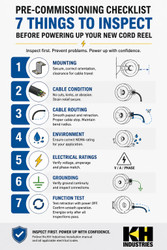
Pre-Commissioning Checklist: 7 Things to Inspect Before Powering Up Your New Reel
Table of Contents
Before an industrial cord reel is placed into service, a systematic pre-commissioning inspection helps identify installation issues, shipping damage, and application mismatches that can affect safety and long-term reliability.
Energizing an uninspected piece of industrial equipment without a systematic protocol can lead to premature mechanical failure, compromised electrical safety, or unexpected compliance challenges down the line.
This industrial cord reel pre-commissioning checklist is designed to help maintenance teams complete a thorough cord reel installation inspection before powering up a cord reel for the first time. It complements the KH Industries installation manual and engineering guidance but does not replace the product instructions or applicable electrical codes.
Whether a facility is integrating our robust, high-volume RTB and RTF models or deploying specialized industrial power products, executing a methodical pre-commissioning phase helps maintain structural integrity and electrical continuity.
Why Pre-Commissioning Inspection Matters for an Industrial Cord Reel
Understanding potential failure points before powering up a new industrial cord reel helps prevent avoidable problems. Manufacturing defects rarely cause early failures. More often, they result from shipping damage, installation errors, or incorrect application.
Skipping a formal pre-commissioning inspection increases the risk of energizing a reel with loose mounting hardware, damaged cord insulation, improper grounding, or incorrect electrical connections. Even damage that isn't immediately visible, such as a bent mounting bracket or stressed internal termination caused during transport, can affect long-term performance.
Environmental mismatches can also accelerate wear. Installing an indoor-rated reel in a wet, corrosive, or washdown environment may lead to premature failure and operational issues. Completing a structured startup inspection helps identify these issues before the reel is placed into service.
The 7-Point Industrial Cord Reel Pre-Commissioning Checklist
To streamline your facility's deployment process, we outline a chronological 7-point cord reel checklist below. This checklist follows the recommended commissioning sequence: inspect the mounting, cord condition, cord routing, electrical ratings, grounding continuity, controlled function, and environmental fit. Utilizing a certified electrical contractor to deploy this cord reel inspection checklist helps verify the reel is ready before any power is applied.
1. Mounting and Structural Integrity
Your cord reel mounting inspection serves as the physical foundation of the entire installation. Verify the reel is mounted to the proper structural support suited for both its static weight and its continuous dynamic duty cycle. When an operator aggressively pulls the cord against heavy mainspring tension, the mounting baseplate experiences amplified lateral and sheer forces.
All cord reel bracket bolts and heavy-duty fasteners must be torqued to the exact specifications outlined in the installation literature. We strongly advise against using undersized hardware or generic drywall anchors; personnel should utilize structural steel bolts, heavy-duty lock washers, and the fastening hardware and installation method specified in the installation documentation. Ensure the bracket or pivot swivel is tightly secured, and check that the specific mounting orientation perfectly matches the manual's directives for ceiling, wall, or floor configurations. Altering the intended orientation affects how the cord spools, which can cause internal binding.
Finally, verify there is adequate spatial clearance for the primary drum to turn and the cord to pay out without obstruction from nearby ductwork, piping, or building infrastructure.
Expert Note: Dynamic loading during rapid retraction exerts significant lateral stress on the baseplate assembly. Relying on inadequate fastening methods can lead to mechanical failure or mounting instability during peak industrial usage.
Read more: Overhead vs. Wall vs. Floor Mounts: Optimizing Your Floor Plan for Cable Retrieval explains how each orientation affects cord spooling and retrieval before you commit to a mounting point.
2. Cord Condition and Integrity
Once the main assembly is mechanically secure, personnel must perform a comprehensive cord reel inspection. Technicians need to inspect the full spooled cord length for hidden shipping or handling damage. Personnel should look actively for deep nicks, cuts, heavy abrasion, or crushing in the rugged SOOW jacket. Such cord damages the internal copper conductors and may affect the assembly's environmental protection performance.
Next, carefully scrutinize the primary cord entry point, the primary strain relief mechanism, and any attached junction boxes. Verify that all visible electrical terminations remain secure and physically undamaged. If the external metal framing of the reel itself appears dented or warped from transport handling, closely check the adjacent cord layers on the spool for friction scoring or pinch marks. Heavy MRO environments demand robust cord integrity, as chemical exposure, such as cutting fluids, hydraulic oils, and specialized solvents, can degrade compromised jackets rapidly.
3. Cord Routing, Payout, and Bend Radius
The mechanical travel path of the conductor requires validation. Confirm that the heavy-gauge cord spools cleanly and pays out evenly across the internal drum. Verify that the heavy-duty ball stop or adjustable cord stop is positioned precisely for the required working length of the operator - a value best established at the spec-and-size stage before the reel ever arrives.
A critical mechanical parameter during any cord payout is the strict observance of the minimum bend radius. The cord must not be forced below its specified minimum bend radius at the outlet guide, roller arm, or any point along its operational path.
For cables under tension (during payout), a common engineering guideline is to maintain a minimum bend radius of at least six times the cable's outside diameter (6× OD), unless the cord manufacturer specifies otherwise. For example, a cord with a 0.65-inch outside diameter would require a minimum bend radius of approximately 3.9 inches (0.65 × 6). Bending the cord more sharply than this can overstress the internal copper strands, leading to premature conductor fatigue and reduced cord life.
4. Environmental and Compliance Fit
The final stage of the pre-commissioning verification ensures the physical equipment precisely aligns with the atmospheric and environmental realities of the installation space. Plant managers must confirm that the installed unit’s outer enclosure and protective rating match the actual operating environment. This includes verifying the specific cord reel NEMA rating for designated indoor, outdoor, or heavy washdown applications.
As part of the final outdoor cord reel check, verify that the enclosure rating and environmental protection match the actual installation conditions before placing the reel into service.
If the industrial operation takes place in a volatile or combustible atmosphere, ensure the strict presence of properly certified Hazardous Location Explosion-Proof Cord Reels. If the installation environment requires hazardous-location equipment, verify that the reel's classification matches the site's requirements and confirm all specifications before installation.
Verify the unit, exactly as installed, meets the site’s overarching safety and compliance mandates. If the operational space dictates daily heavy washdown procedures, a standard indoor-rated assembly must be immediately swapped for an appropriately sealed outdoor industrial cord reel.
Consider the fundamental differences outlined in standard environmental ratings below:
| Enclosure Rating | Typical Industrial Environment | Core Protection Profile |
|---|---|---|
| NEMA 2 | Standard Indoor Warehousing | Designed to mitigate falling dirt and dripping water. |
| NEMA 4 | Washdown Facilities | Protects internal components against directed hose-down splashing. |
| NEMA 4X | Corrosive Marine / Shipyards | Adds severe corrosion resistance to baseline NEMA 4 specifications. |
| Class I, Div 1 | Chemical processing environments and other classified hazardous locations. | Specifically engineered for continuously volatile explosive gases. |
Read more: NEMA 4X: Why Standard Enclosure Ratings Fail in Corrosive Industrial Environments explains what the 4X rating actually protects against and where standard enclosures fall short.
5. Electrical Ratings Match (Voltage, Amperage, Phase)
Before making any live physical terminations to the facility's power grid, technicians must verify that the facility's supply voltage, maximum amperage, and electrical phase match the printed nameplate rating located on the reel. Ensuring a strict electrical ratings match is arguably the most critical step of the entire sequence, as a cord reel voltage check or cord reel amperage rating mismatch represents the most common and costly commissioning error.
Connecting a low-voltage internal slip ring directly to a high-voltage industrial bus duct can damage internal components. Furthermore, confirm that the upstream facility breaker and local circuit protection are correctly sized for both the cord reel itself and the anticipated connected load at the end of the line. It is crucial to remember that duty cycles dictate thermal load; continuous heavy draws differ drastically from intermittent usage.
Always compare the reel's nameplate information with the facility's electrical supply before making final connections. A quick nameplate verification can prevent one of the most common commissioning errors.
Read more: Why Amperage De-rating Rules Matter for Fully Coiled Industrial Reels explains how duty cycle and coiling reduce a reel's safe amperage below its nameplate free-air rating.
6. Grounding and Electrical Continuity
Performing a methodical ground continuity check is essential. The internal slip ring plays a vital role in maintaining this critical electrical continuity while the main drum turns actively under heavy load. We recommend that technicians use a calibrated multimeter to accurately verify ground resistance along the entire electrical circuit before the final sign-off. Proper cord reel electrical safety requires a continuous, low-impedance ground path to protect operators in damp or conductive industrial environments.
7. Controlled Function and Retraction Test
With all static mechanical and de-energized electrical checks completed, personnel can safely proceed to the dynamic functional testing phase. First, conduct a slow, mechanical cord reel retraction test while the unit remains entirely de-energized. Pull the heavy cord out to its maximum operational limit and allow it to retract in a controlled, hand-guided manner.
During this motion, verify that the payout action remains smooth and that the internal cord reel ratchet check confirms the mechanical latch holds firmly at distinct, predictable intervals.
Expert Note: A primary cause of premature slip ring failure is operators simply dropping the cord and allowing it to violently snap back into the drum housing. This sudden kinetic shock transfers directly into the sensitive internal brush assemblies.
Read more: Industrial Cord Reel Maintenance Guide: 5 Steps to Extend Spring Life & Cycles covers how controlled retraction protects the spring and slip ring over the reel's life
After Commissioning: Building a Cord Reel Maintenance Routine
Passing the initial pre-commissioning phase does not conclude the management of the electrical equipment. A successful, error-free startup simply marks the beginning of the reel's active service life, not the end of your facility's inspection obligations.
To maximize the lifecycle and preserve critical operational uptime, facilities must actively transition from a one-time startup protocol to an ongoing cord reel maintenance schedule. Implementing structured cord reel preventive maintenance involves establishing a recurring inspection cadence focusing heavily on outer cord integrity, secure electrical terminations, mounting bracket stability, and smooth mechanical retraction.
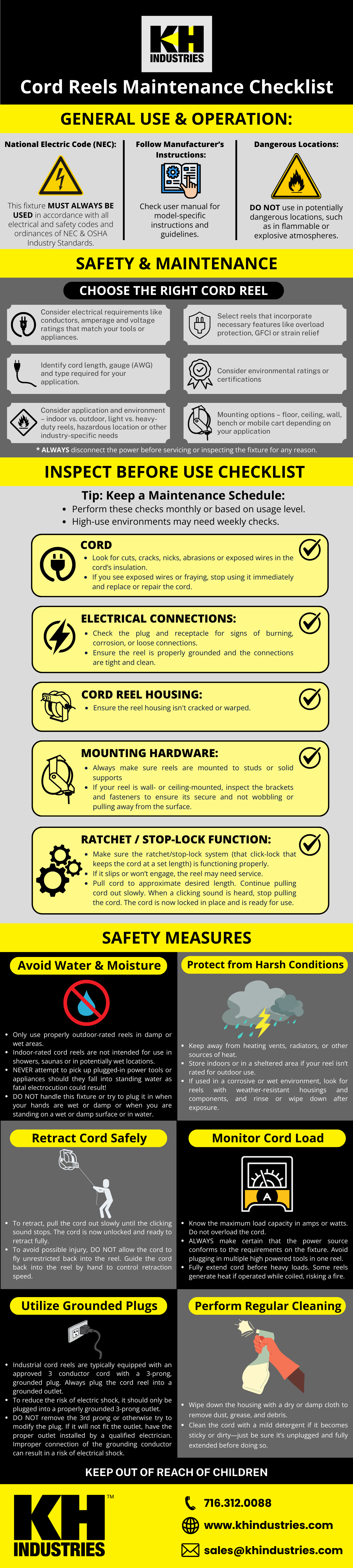
After commissioning is complete, establish a recurring inspection schedule based on your operating environment and duty cycle. For a structured inspection process, use the KH Industries Cord Reel Maintenance Checklist alongside the product documentation to help support long-term equipment reliability.
Read more: The Industrial Cord Reel Annual Maintenance Schedule: 2026 Guide for Facility Managers turns that recurring cadence into a ready-to-use annual plan
Need Help Selecting the Right Reel?
If commissioning reveals a ratings mismatch or an issue with the application, it is advisable to consult with a KH Industries expert to verify the correct reel configuration before installing and putting the unit into service.