

Industrial Cord Reel Annual Maintenance Schedule: 2026 Maintenance Guide for Facility Managers
Table of Contents
- Why Cord Reel Maintenance Supports Safety and Operational Goals
- How to Set Up Your Cord Reel Maintenance Program
- Use the KH Cord Reels Maintenance Checklist to Standardize Inspections
- Monthly Cord Reel Inspection Tasks
- Quarterly Cord Reel Inspection Tasks
- Semi-Annual Cord Reel Inspection Tasks
- Annual Cord Reel Inspection and Replacement Assessment
- Maintenance Schedule Summary: 2026 Inspection Frequency Table
- Keep Your Facility Performing All Year: Start With the Right Baseline
- Frequently Asked Questions
Neglected cord reel maintenance is not an abstract issue; it is a tangible operational bottleneck. A retractable cord reel with a worn spring mechanism or cracked insulation on the cord set can create trip hazards, electrical risks, and unplanned downtime.
Facility managers, maintenance supervisors, and MRO leads responsible for cord reels across a production floor, hangar, dock, or utility yard need a structured system to prevent these failures. This guide delivers exactly that: a structured annual maintenance schedule broken into monthly, quarterly, semi-annual, and annual tasks, plus a checklist structure your team can implement directly on the facility floor.
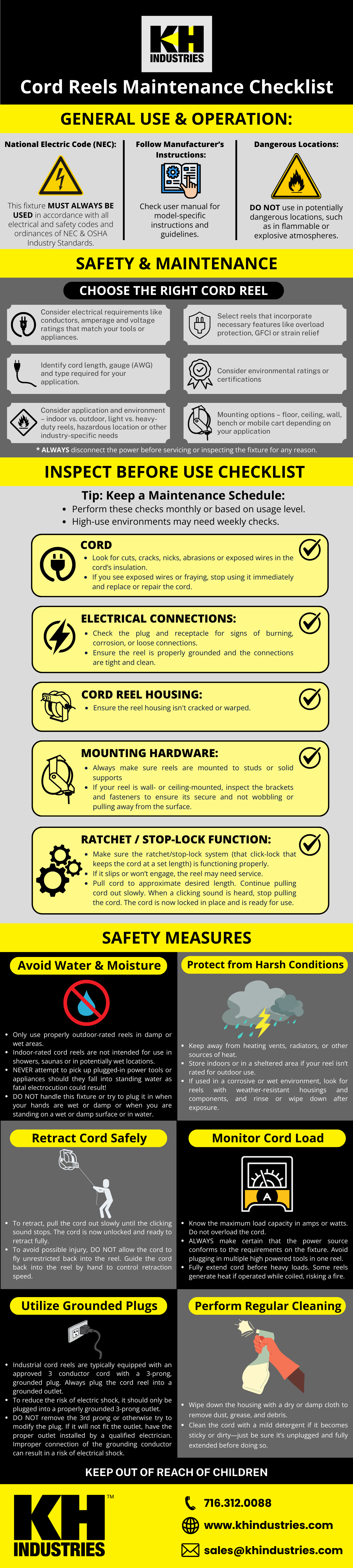
Implement a consistent inspection process across your facility with the KH Industries Cord Reels Maintenance Checklist. The checklist can be used alongside paper inspection logs, CMMS platforms, or facility maintenance software to help document routine cord reel inspections and maintenance activities.
Download:KH Industries Cord Reels Maintenance Checklist
Read more: The Hidden Culprit of Factory Downtime: How Improper Cable Spooling Costs Thousands quantifies what reel-related downtime actually costs a facility
Why Cord Reel Maintenance Supports Safety and Operational Goals
Industrial equipment experiences continuous mechanical and electrical wear during normal operation. Establishing a baseline for maintenance helps facilities align with broader safety objectives and operational efficiency.
- OSHA Guidelines: OSHA's general industry electrical standards require flexible cord sets to be visually inspected before use on any shift (29 CFR 1910.334). Cord reels fall under these checks because OSHA regulates a reel as a flexible cord set. Read more about OSHA Standards for Industrial Facilities: What Compliant Cord Management Looks Like covers the cord-management requirements behind these inspection rules.
- Trip Hazards and Housekeeping: OSHA's walking-working surface and housekeeping requirements come into play when a reel fails to retract and leaves a cord across walkways.
- Documentation: A documented inspection program helps support maintenance records, safety initiatives, and compliance efforts.
Hazardous Location Cord Reels: Specific Assessment Requirements
If your facility operates hazardous-location cord reels, these assemblies require additional inspection considerations.
Class I, Division 1 and Division 2 cord reels installed in hazardous locations are subject to specific inspection requirements. The explosion-proof enclosure is designed to remain sealed and undamaged to function correctly. Any modification or damage to a hazardous-location enclosure should be evaluated against the applicable certification needs and manufacturer guidance.
Because of the environmental stakes, these reels should be inspected diligently by qualified personnel. For heavy-duty hazardous applications, consult our line of Hazardous Location Explosion-Proof Cord Reels.
How to Set Up Your Cord Reel Maintenance Program
Before any schedule can be followed, a facility needs an operational baseline. Inspection frequency should be adjusted based on duty cycle, environment, manufacturer recommendations, and facility maintenance practices.
Establish your baseline in three steps:
- Inventory Every Cord Reel: Log the ID number, specific location, model/type, age, and last inspection date. A maintenance program without a proper asset register is difficult to track.
- Assign Ownership: Every individual reel should have a named responsible person or maintenance team.
- Choose a Logging System: Use a paper log attached directly to the reel, a digital facility management system, or the KH Industries Cord Reels Maintenance Checklist.
Use the KH Cord Reels Maintenance Checklist to Standardize Inspections
Even well-designed maintenance programs can become inconsistent when inspection records are scattered across notebooks, spreadsheets, and individual technicians. Standardized documentation helps maintenance teams track inspection intervals, identify recurring issues, and maintain a clear service history for each reel,
Whether you manage a handful of reels or hundreds of assets across multiple facilities, a consistent inspection process can help improve maintenance visibility and support long-term equipment reliability.
Monthly Cord Reel Inspection Tasks
High-cycle reels see constant mechanical demand. A monthly visual inspection catches surface-level wear before it escalates into a mechanical lockup or an electrical fault.
| Task | What to Look For | Action if Issue Found |
|---|---|---|
| Visual inspection of the cord | Check for cracks, fraying, abrasion, or discoloration. | Tag out and schedule cord replacement. |
| Check the cord connector and plug | Look for bent pins, a cracked housing, or loose connections. | Replace the plug end as needed. |
| Inspect the retraction function | Does the reel retract smoothly? Sticking signals spring wear. | Adjust tension or mark for spring service. |
| Check reel mounting | Inspect mounting bolts, brackets, and ceiling mount hardware. | Retorque loose fasteners to spec. |
| Inspect cord guide/stopper | Check for wear, cracking, or misalignment. | Replace damaged guides. |
| Check for trip hazards | Ensure the cord is properly retracted when not in use. | Correct operator behavior or check the spring. |
Read more:Overhead vs. Wall vs. Floor Mounts: Optimizing Your Floor Plan for Cable Retrieval explains how mount type affects hardware stability and long-term wear.
Quarterly Cord Reel Inspection Tasks
Quarterly inspections expand beyond visual checks to include electrical and mechanical verification. Some inspection or repair activities should be performed by qualified personnel. Where refurbishment is required, the reel may need to be returned to the manufacturer.
| Task | What to Look For | Action if Issue Found |
|---|---|---|
| Inspect the internal cord path | Partial unspooling required. Check for kinking, pinching, or abrasion. | Respool correctly or replace the cord. |
| Check electrical continuity | Use a continuity tester or multimeter to verify the full cord path. | Service the slip ring or replace the wiring. |
| Inspect slip ring/rotary contact | Look for excessive carbon buildup, oxidation, or wear. | Clean contacts or schedule a replacement. |
| Check spring tension | The reel should retract without sluggishness; a slow return indicates fatigue. | Adjust the tension or order a replacement spring. |
| Inspect NEMA enclosures | Check gaskets and enclosure integrity for NEMA-rated models. | Replace gaskets to maintain environmental ratings. |
| Check cord markings/labels | Ensure capacity markings and labels are legible and not obscured. | Replace missing labels. |
Semi-Annual Cord Reel Inspection Tasks
Semi-annual inspections provide a deeper assessment of mechanical and electrical performance, particularly for reels operating outdoors or in demanding environments. More extensive service or repair should be completed by qualified personnel or coordinated with the manufacturer where appropriate.
| Task | What to Look For | Action if Issue Found |
|---|---|---|
| Full cord inspection under load | Inspect the cord at all points of travel through the reel with the cord extended. | Tag out if localized heating or a voltage drop occurs. |
| Slip ring resistance test | Measure contact resistance at the rotary union. | Replace the slip ring assembly if resistance is elevated. |
| Inspect the reel spring mechanism | If housing allows access, inspect the spring for fatigue or corrosion. | Replace the spring canister. |
| Check the reel housing | Look for cracks, corrosion, or mechanical damage. | Replace damaged housing components. |
| Torque check on all fasteners | Check mounting bolts, outlet box screws, and cord clamp hardware. | Tighten to the manufacturer's specifications. |
| Verify certification labels | Ensure certification labels are legible and intact. | Contact the manufacturer for documentation. |
Read more:Why Amperage De-rating Rules Matter for Fully Coiled Industrial Reels explains why localized heating shows up in coiled cord and how de-rating prevents it.
Annual Cord Reel Inspection and Replacement Assessment
The annual inspection is the most thorough interval. It rolls up the monthly, quarterly, and semi-annual schedules into a formal replacement assessment to help MRO teams budget for the coming year.
| Task | What to Look For | Action if Issue Found |
|---|---|---|
| Complete electrical test | Perform an insulation resistance test on the full cord length. | Replace the cord set if the insulation degrades. |
| Full disassembly inspection | Where the maintenance manual permits, inspect internal components. | Clean, lubricate, or replace worn internals. |
| Cord replacement decision | Evaluate cord condition against the manufacturer's replacement criteria. | Order replacement cord assembly. |
| Reel mechanism assessment | Springs, slip rings, and rotary contacts have finite service lives. | Rebuild or replace the unit. |
| Update facility asset register | Record inspection date, technician, findings, and replacements. | Finalize documentation log. |
When to Replace vs Repair: Cord Reel End-of-Life Indicators
If routine inspections identify damage beyond normal maintenance, evaluate whether the reel should be repaired, refurbished, or replaced based on the manufacturer's recommendations. Factors such as electrical integrity, structural condition, and component availability all influence this decision.
Key replacement triggers include:
- Cord insulation resistance falls below the manufacturer's minimums.
- Visible conductor exposure or a jacket breach that cannot be safely addressed.
- Slip ring contact resistance remains persistently elevated despite cleaning.
- The spring mechanism no longer retracts the cord as intended by the manufacturer.
- Mounting hardware or structural frame failure occurs that cannot be safely repaired.
- A NEMA enclosure seal or gasket failure compromises the enclosure rating.
Contact our engineering team for a replacement recommendation based on your specific operational environment.
Read more:Retrofitting vs. Replacing: When Can You Upgrade an Existing Cord Reel? walks through the repair-versus-replace decision in detail.
Maintenance Schedule Summary: 2026 Inspection Frequency Table
As above: adjust these intervals to each reel's duty cycle, environment, and the manufacturer's recommendations.
| Inspection Task | Monthly | Quarterly | Semi-Annual | Annual |
|---|---|---|---|---|
| Visual inspection of cord & plug | Yes | Yes | Yes | Yes |
| Inspect retraction function & trip hazards | Yes | Yes | Yes | Yes |
| Test electrical continuity | No | Yes | Yes | Yes |
| Check internal cord path & slip ring contacts | No | Yes | Yes | Yes |
| Inspect enclosure seals & gaskets | No | Yes | Yes | Yes |
| Slip ring resistance test & spring mechanism | No | No | Yes | Yes |
| Torque check on all mounting hardware | No | No | Yes | Yes |
| Insulation resistance test | No | No | No | Yes |
| Full disassembly & replacement assessment | No | No | No | Yes |
Keep Your Facility Performing All Year: Start With the Right Baseline
A documented maintenance program delivers on crucial operational levels: safety, productivity, and sensible lifecycle management. Preventive maintenance extends service life and helps defer unnecessary replacement costs.
A consistent maintenance program helps maximize cord reel reliability, improve equipment availability, and reduce unexpected downtime. If inspection identifies worn components or a reel approaching the end of its service life, the KH Industries engineering team can help identify appropriate replacement options.
Read more: Direct Replacement Guide: How to Swap Your Legacy Reel for a KH Industrial Retractable Cord Reel walks through matching a replacement to a discontinued or worn-out unit
Frequently Asked Questions
How often should industrial cord reels be inspected?
While standard practices suggest monthly visual checks, quarterly electrical checks, and an annual full inspection, frequency should ultimately be determined by the duty cycle and operating environment.
Can I repair a damaged cord on a cord reel myself?
Minor cord set replacements by a qualified electrician are generally acceptable for standard reels. However, any modification to a hazardous-location reel enclosure should only be evaluated and performed according to the manufacturer's and certification guidelines.
How long do cord reels last?
Service life varies depending on duty cycle, environment, maintenance practices, and application.
What is the most common cord reel maintenance issue?
Slip ring wear and spring fatigue are common maintenance issues in high-cycle applications. Routine inspection helps mitigate these before they cause downtime.