

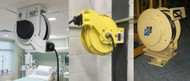
Industrial Cord Reel Mounting: Overhead vs. Wall vs. Floor Mounts
Table of Contents
- Why Industrial Cord Reel Mount Placement Drives Floor-Plan Efficiency
- Overhead Mounts: Maximizing Floor Space
- Wall and Column-Mounted Industrial Cord Reels: Perimeter and Workstation Power
- Floor and Pedestal-Mounted Industrial Cord Reels: Open-Area and Mobile Access
- Matching Your Industrial Cord Reel Mount Type to Workspace and Workflow
- How Mount Choice Affects Industrial Cord Reel Specification
In many facilities, cord reel performance is judged by cord length, amperage, or retraction type. Yet the mounting location can be just as important. A properly positioned industrial cord reel helps keep power accessible, supports efficient cord retrieval, reduces unnecessary cord wear, and contributes to a safer, more organized workspace. KH Industries offers industrial retractable extension cord reels for overhead, wall, column, and floor-mounted applications, helping facilities match reel configuration to workspace requirements.
Understanding different cord reel mounting options is essential because cord reel placement directly affects efficiency, safety, and day-to-day operations. When evaluating overhead vs wall vs floor cord reel solutions, facilities must consider how each mounting approach fits their workflow and available space.
Overhead, wall, column-mounted, and floor-mounted installations each support different operational requirements. Selecting the most appropriate mounting approach depends on facility layout, operator movement patterns, traffic flow, and where power is needed throughout the workspace.
This guide explains how each mounting approach affects cord retrieval, workspace efficiency, service accessibility, and cord management so engineers, maintenance teams, EHS personnel, and purchasing teams can make informed specification decisions.
Why Industrial Cord Reel Mount Placement Drives Floor-Plan Efficiency
Cord reel placement affects cord retrieval, traffic flow, floor-space utilization, and cord protection. Selecting a mounting location that aligns with operator movement patterns helps keep power accessible while reducing unnecessary cord drag and congestion. An effective industrial cord management layout starts with selecting the right mounting location and designing a cord reel floor plan that supports daily operations.
Most industrial facilities use one of three primary mounting approaches: overhead installations attached to structural supports, wall or column-mounted systems positioned around the perimeter, and floor or pedestal-mounted reels located directly within the work area. Each approach offers distinct advantages depending on workflow requirements and facility layout.
Overhead Mounts: Maximizing Floor Space
An overhead cord reel mount positions a cord reel above the work area using a ceiling structure, beam, overhead support, or dedicated mounting bracket.
In many facilities, a ceiling-mount cord reel helps maximize usable floor space, while an overhead cord reel keeps power accessible without interfering with daily operations. In facilities where floor space is limited or equipment movement is constant, an overhead installation can help keep cords accessible while reducing interference with daily operations.
Primary Advantages
One of the primary advantages of overhead mounting is that cords remain elevated when not in use. By allowing the cord to descend from above, facilities can reduce exposure to vehicle traffic, rolling equipment, and pedestrian pathways while maintaining a cleaner work area.
Because the reel is mounted above the workspace, overhead installations avoid consuming production or maintenance floor area and can support operations where equipment, materials, and personnel share limited space.
Installation Considerations
Overhead mounting requires adequate structural support and sufficient ceiling clearance. The reel location should allow operators to comfortably reach and retrieve the cord without excessive stretching or awkward positioning. Depending on the layout, facilities may also use guide arms or drop supports to help direct the cord to the desired work zone.
Overhead mounting is often a practical choice for open work areas where cords must remain accessible while staying clear of surrounding operations. Facilities often consider overhead mounting when cords must remain accessible while staying clear of traffic routes and equipment movement.
Expert Note: Before selecting an overhead mounting location, evaluate both the cord retrieval path and the operator's working position. A reel that is mounted too high or too far from the point of use may reduce the efficiency gains that overhead placement is intended to provide.
Wall and Column-Mounted Industrial Cord Reels: Perimeter and Workstation Power
A wall-mount cord reel or column-mount cord reel is installed on vertical structures such as perimeter walls, support columns, equipment frames, or workstation areas. This mounting approach is often used when power needs to remain accessible within a defined work zone while keeping cords off the floor and out of the way when not in use. A wall-mounted cord reel is particularly effective in workstations where operators require convenient access to power.
Primary Advantages
One advantage of wall-mounted installations is their accessibility. Because the reel is positioned near the work area, operators can typically retrieve and return the cord without moving far from their workstation. This makes wall-mounted systems well-suited for maintenance benches, repair stations, and perimeter production cells where power requirements remain relatively predictable.
Typical Applications
Wall and column-mounted reels are commonly used in maintenance areas, workstations, and perimeter operations where convenient access, defined cord-retrieval paths, and flexibility around existing facility infrastructure are priorities.
Structural columns often provide practical mounting locations in manufacturing plants, warehouses, and service facilities where ceiling-mounted installations may not be practical or where power is needed closer to the point of use. In some applications, swivel mounting bases or fixed mounting bases can help accommodate varying pull angles.
Placement Considerations
The primary consideration with wall-mounted systems is working reach. Because the reel operates from a fixed vertical location, the cord must be capable of reaching all intended work areas without creating unnecessary floor drag or crossing major traffic routes. Facilities should evaluate both cord length requirements and operator movement patterns when determining placement.
Wall-mounted reels work best where power is needed within a defined workstation or perimeter work area.
Floor and Pedestal-Mounted Industrial Cord Reels: Open-Area and Mobile Access
A floor-mount cord reel or pedestal cord reel is installed directly within the work area rather than being attached to a wall or overhead structure. Depending on the application, a floor-mounted cord reel may be mounted on a pedestal, stand, post, or other dedicated support positioned close to where power is needed. This mounting approach is commonly used when there are no suitable walls or overhead structures available or when equipment and personnel operate within large open workspaces.
One of the primary advantages of floor-mounted installations is proximity to the point of use. Positioning the reel within the active work area can reduce the distance between power and equipment, making this approach useful in large production bays, warehouse operations, and island workstations.
However, floor and pedestal installations require careful planning. Unlike overhead or wall-mounted systems, floor-mounted reels occupy workspace and must be positioned carefully to avoid interfering with traffic routes, equipment access, or routine operations.
Expert Note: Before selecting a floor-mounted location, map the expected cord retrieval path and surrounding traffic patterns. Positioning the reel closer to the actual work zone often provides better results than simply placing it in the nearest available floor space.
Comparison of Industrial Cord Reel Mounting Options: Overhead vs Wall vs Floor Cord Reel
This cord reel mount comparison shows how each mounting option performs across key factors such as floor space, cord retrieval, installation requirements, and typical applications, making it easier to evaluate the best solution for your facility.
| Criteria | Overhead Mount | Wall/Column Mount | Floor/Pedestal Mount |
|---|---|---|---|
| Floor Space Usage | No floor footprint | No floor footprint | Requires floor space |
| Trip-Hazard Exposure | Typically reduced when properly installed | Low when properly positioned | Depends on cord routing and traffic patterns |
| Cord Retrieval Pattern | Vertical drop from above | Horizontal pull from the perimeter | Point-of-use retrieval |
| Structural Requirements | Ceiling, beam, or overhead support required | Wall, column, or vertical structure required | Secure floor or pedestal installation required |
| Service Accessibility | May require a lift or elevated access | Generally easier to access | Typically accessible at the working level |
| Best-Fit Applications | Assembly lines, service bays, hangars | Workstations, benches, perimeter operations | Open bays, island workstations, mobile operations |
| Installation Complexity | Moderate to high | Moderate | Moderate |
| Primary Advantage | Preserve floor space and keep cords elevated | Convenient access at defined workstations | Places power directly where work occurs |
| Typical Work Pattern | Open-area work zones | Fixed workstations | Island/mobile operations |
Matching Your Industrial Cord Reel Mount Type to Workspace and Workflow
Choosing a cord reel mount starts with evaluating structural support availability, cord reach requirements, retrieval frequency, and traffic flow patterns. This cord reel mounting guide helps facilities select the right solution while considering the overall cord reel for workshop layout and operational workflow. These factors often influence day-to-day usability as much as the mounting style itself.
Structural Support
Ceiling height and structural support should also be evaluated early in the planning process. Overhead installations require appropriate mounting structures and sufficient clearance for safe cord retrieval. If adequate overhead support is unavailable, wall or floor-mounted alternatives may provide a more practical solution.
Cord Reach and Retrieval
Cord reach and retrieval frequency should be evaluated together. A reel that is used occasionally may have different placement requirements than one that is retrieved and retracted repeatedly throughout every shift. Positioning the reel closer to the actual work area can help reduce unnecessary cord travel and improve day-to-day usability.
The following examples illustrate how mounting decisions often align with common industrial environments:
| Workspace Environment | Common Mounting Approach |
|---|---|
| Assembly lines | Overhead mounting |
| Vehicle service bays | Overhead mounting |
| Aircraft hangars | Overhead or floor-mounted systems |
| Maintenance workstations | Wall- or column-mounted systems |
| Perimeter workbenches | Wall-mounted systems |
| Warehouse island stations | Floor- or pedestal-mounted systems |
| Open production bays | Floor-mounted or overhead systems |
| Mobile service areas | Floor-mounted systems |
Mounting, Safety, and Cord-Retrieval Best Practices
Regardless of the mounting style selected, proper installation and cord reel safety practices play an important role in long-term performance. A well-positioned cord reel should support smooth cord retrieval while helping maintain an organized and efficient workspace and reducing the risk of a cord reel trip hazard.
Structural Support
The mounting structure should be capable of supporting the reel, cord, and expected operating loads. Whether the reel is installed overhead, on a wall, or on a pedestal, mounting hardware should be appropriate for the structure and installed according to the installation instructions and manufacturer guidance. Facilities should also verify that the reel location provides adequate clearance for cord extension and retraction.
Cord Retrieval
Cord retrieval paths deserve careful attention during planning. The cord should move freely between the reel and the point of use without excessive rubbing, sharp directional changes, or unnecessary contact with nearby equipment. Positioning the reel so the cord follows a natural path can help support smoother operation and reduce avoidable wear over time.
Cord Stop Adjustment
For retractable systems, the adjustable ratchet or adjustable ball stop should be modified to provide a practical working length while preventing the connector or accessory from retracting beyond a convenient retrieval point. Operators should also allow the cord to retract in a controlled manner rather than permitting rapid or uncontrolled retraction.
Read more: Why Amperage De-rating Rules Matter for Fully Coiled Industrial Reels explains why controlled retraction and correct working length protect both the cord and its rating.
Traffic Flow
Traffic flow is another important consideration. Retrieval paths should be planned to reduce interference with forklifts, carts, vehicles, and pedestrian walkways whenever possible. In busy maintenance, manufacturing, and MRO environments, even a well-specified reel can become less effective if the cord must repeatedly cross active traffic areas.
Inspection and Maintenance
Facilities should also account for the stored energy within spring-driven systems. Inspection, maintenance, and adjustment activities should be performed using appropriate procedures and manufacturer guidance.
Finally, periodic inspection of the cord, mounting hardware, guide components, and retrieval path can help identify wear, damage, or positioning issues before they affect daily operations. Small adjustments to cord routing or reel placement can often improve usability and support more consistent cord management throughout the facility.
Expert Note: Many cord-management issues become apparent only after equipment begins operating. Traffic flow, retrieval frequency, structural support, and operator movement should all be evaluated together when selecting a mounting location.
Read more: Industrial Cord Reel Maintenance Guide: 5 Steps to Extend Spring Life & Cycles covers inspection cadence and safe spring service in detail.
How Mount Choice Affects Industrial Cord Reel Specification
Cord Length
Cord reel cord length is one of the first considerations. An overhead-mounted reel may require additional cord length to accommodate the vertical drop from the mounting location to the work area. Floor-mounted installations may require different cord lengths depending on how far the reel is positioned from the point of use. Selecting the appropriate cord length helps support efficient retrieval while avoiding unnecessary excess cord.
Read more: How to Spec and Size an Industrial Cord Reel walks through calculating active reach, vertical drop, and slack allowance step by step.
Mounting Accessories
Mounting style may also influence accessory requirements. Overhead installations sometimes use guide arms or cord-management accessories to direct cord movement. For workstations needing multiple outlets at the point of use, a portable outlet box can be specified alongside the reel. At the same time, wall-mounted systems may incorporate swivel brackets or a cord reel mounting bracket to accommodate varying pull angles. Floor-mounted installations often require careful consideration of mounting footprints and surrounding traffic patterns.
Environmental Conditions
Environmental conditions should also be considered during specification. Facilities operating outdoors may evaluate outdoor industrial cord reels, while applications exposed to moisture, washdown conditions, or classified environments may require additional review of enclosure and application requirements.
Mounting Structure
The mounting structure itself is another specification factor. Ceiling supports, wall structures, columns, and pedestal installations all have different installation requirements that should be evaluated during planning. Reviewing CAD resources and dimensional drawings during layout planning can help confirm mounting clearances, structural requirements, and cord-retrieval paths before installation.
Planning Considerations
Because mounting location, cord reach, operating environment, and retrieval requirements are closely connected, facilities often evaluate these factors together when selecting a cord reel configuration. Reviewing structural requirements, cord paths, and workspace constraints during planning can help support a more effective installation.
Not sure which mount fits your floor plan and reel specification? Talk to an expert to evaluate your layout and application requirements, or request a Quote to configure and price the right mounted reel for your facility.


