

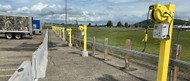
Powering a Multi-Bay Fleet Maintenance Yard: Why Cord Reel Power Stations Outperform Mounted Reels and Fixed Pedestals
Table of Contents
- What a Multi-Bay Fleet Maintenance Yard Actually Demands From a Power Solution
- Option 1: Mounted Cord Reels: The Right Tool in the Right Building
- Option 2: Fixed Power Pedestals: Permanent Infrastructure With Permanent Tradeoffs
- Option 3: KH Industries Cord Reel Power Stations: Built for Exactly This Problem
- Side-by-Side Comparison: All Three Solutions Against Fleet Yard Demands
- Sizing a KH Industries Cord Reel Power Station for Your Fleet Yard
- The Right Tool for the Right Environment
- Frequently Asked Questions
A fleet maintenance yard rarely has just one job happening at a time. Four to six bays of trucks or buses may need power at the same time for oil changes, brake checks, electrical diagnostics, and pre-trip inspections. Technicians need access to 120V power at different positions, often in an outdoor or semi-outdoor environment where rain, vehicle movement, and changing work locations complicate cord management.
The challenge is multi-bay power distribution across a fleet yard: deliver power to each position without leaving cords across drive lanes or committing to infrastructure that may not fit future layouts.
Facilities generally evaluate three approaches: individually mounted cord reels, fixed power pedestals, and multi-reel power stations. Each has a legitimate use case. The right cord reel power station for fleet maintenance depends on the yard layout, environmental exposure, installation requirements, and number of technicians working at once. A fleet maintenance power solution should provide separate drops without making every bay dependent on permanent construction.
What a Multi-Bay Fleet Maintenance Yard Actually Demands From a Power Solution
Before comparing the options, establish five criteria for evaluating a fleet maintenance power solution. These requirements provide a consistent way to assess mounted reels, fixed pedestals, and power stations.
1. Simultaneous Multi-Position Access
Four active bays may need four independent cord drops; six active positions may require six. The objective is to provide each technician with suitable power access without relying on one shared extension cord or creating conflicts between adjacent work areas.
2. Outdoor And Weather-Rated Components
Fleet yards experience rain, humidity, vehicle wash overspray, and temperature changes. Every component must be suitable for its installation environment. NEMA 4 and NEMA 4X ratings are important selection considerations, but the correct rating depends on the specific configuration and site conditions.
3. reduces trip Hazard Across Drive Lanes
Trucks and heavy equipment move through the yard throughout the day. Cords left across walking paths or vehicle routes create trip and equipment-damage risks. A suitable outdoor cord reel power station should help keep unused cord off the ground through automatic retraction.
4. Minimal Infrastructure Disruption To Install
Trenching paved yards for conduit can involve cutting asphalt or concrete, installing conduit, and restoring the surface. The preferred installation should provide power where work takes place while avoiding unnecessary disruption. The existing electrical supply and installation requirements still need to be assessed.
5. Automatic Cord Control - Retraction, Not Coiling
At the end of a shift, unused cords need to be stored consistently. Manual coiling depends on technicians remembering to complete the task every time. A retractable cord reel for outdoor fleet applications helps make cord storage part of the equipment's operating process.
Option 1: Mounted Cord Reels: The Right Tool in the Right Building
Mounted retractable electric cord reels provide controlled power access at a defined work position. They are particularly useful where a suitable ceiling, wall, or structural post already exists and the reel can be positioned close to the equipment being serviced.
Where Mounted Cord Reels Excel
A spring-retractable reel stores unused cord in its housing and returns the cord when retraction is engaged according to the manufacturer's instructions. The cord can be extended for a task and stored afterward, helping keep the floor clear. Appropriate outdoor configurations are available with NEMA 4 or NEMA 4X ratings, depending on the selected model.
For enclosed service bays and vehicle lift areas, Indoor Industrial Cord Reels and Heavy Duty Retractable Cord Reels offer product families to evaluate. Outdoor installations should be matched to the exposure and the selected reel's specifications.
For a broader comparison of indoor and outdoor applications, see Extension Cord Reels for Indoor and Outdoor Applications.
Where Mounted Cord Reels Hit A Hard Limit In The Fleet Yard
Every mounted reel needs a suitable mounting point near its work position. In an open yard without overhead infrastructure, that may mean adding structural posts, supports, and electrical connections. The installation scope can grow as more bays are added.
A reel mounted on the building exterior may reach the bays immediately beside the wall but may not provide sufficient working reach for positions farther into the yard. Adding posts at individual bays may require concrete work, structural installation, and electrical rough-in.
This is not a limitation of the reel itself. Mounted reels are excellent products for fixed positions in enclosed service bays or vehicle lift areas with suitable existing infrastructure. An open-air, multi-bay fleet yard presents a different power-distribution challenge.
Scorecard: Mounted cord reels vs. fleet yard demands
| Evaluation criterion | Assessment |
|---|---|
| Simultaneous multi-position access | Possible, with suitable mounting and electrical provisions at each position |
| Weather-rated components | Available with appropriately rated configurations |
| reduces trip hazard | Automatic retraction helps keep unused cord off the ground |
| Minimal installation disruption | May require additional mounting structures and electrical work |
| Automatic cord return | Available on spring-retractable models |
Option 2: Fixed Power Pedestals: Permanent Infrastructure With Permanent Tradeoffs
Fixed power pedestals bring electrical receptacles closer to vehicles through a hardwired post or enclosure. They are a legitimate option for permanent service positions, fueling areas, and wash bays where equipment locations are predictable and the layout is unlikely to change.
What Fixed Pedestals Do Well
A fixed pedestal can provide multiple receptacles and suitable electrical protection close to the point of use. With an appropriately rated enclosure and correctly designed installation, it can provide a durable source of power for a designated work area.
For facilities building permanent infrastructure around a known layout, a pedestal can be a sensible long-term choice. Its value lies in providing fixed power where the location is expected to remain useful.
The Installation And Flexibility Problem
In an existing paved fleet yard, adding a hardwired pedestal may require a conduit route from the electrical supply. Depending on the site, installation can involve cutting asphalt or concrete, trenching, laying conduit, and restoring the surface. Work may also require temporary restrictions around the affected bays.
The second tradeoff is flexibility. Pedestals remain where they are installed. If fleet capacity expands, maintenance work moves, or the yard is reorganized, bringing power to the new positions may require another installation project.
A pedestal also does not automatically manage the cord connected to it. Technicians still need to deploy, route, and store their cords appropriately. That leaves a multi-bay power distribution fleet yard with a separate cord-management requirement.
Scorecard: Fixed pedestals vs. fleet yard demands
| Evaluation criterion | Assessment |
|---|---|
| Simultaneous multi-position access | Possible, with electrical infrastructure at each position |
| Weather-rated components | Weather-rated enclosures are available |
| reduces trip hazard | Receptacles alone do not manage trailing cords |
| Minimal installation disruption | Paved-yard trenching and electrical work may be required |
| Automatic cord return | Not provided by the pedestal itself |
Option 3: KH Industries Cord Reel Power Stations: Built for Exactly This Problem
A cord reel power station for fleet maintenance combines multiple retractable cord reels with an electrical distribution arrangement on a pole or foundation mount. Instead of treating every bay as an isolated installation, the station brings several power drops together at a planned location.
KH Industries offers configurable stations with one to four reels, 3-foot or 6-foot pole options, tiered reel elevations, outlet-layout choices, and electrical configurations that vary by model. Available options include NEMA 4 and NEMA 4X reel configurations, with 50-foot SOOW cord options. Confirm the specifications for the particular station before selecting it.
Simultaneous Multi-Bay Coverage
A station configured with four reels can provide four separate cord drops from one station location, subject to the selected electrical configuration and available power supply. This can suit a four-position work area where technicians need independent access to power.
On compatible 6-foot configurations, reels can be arranged at two elevations. This gives facilities another option when the work includes both standing-height tool use and lower vehicle service positions. Match the precise reel arrangement to the yard's working envelope.
Outdoor And Weather-Rated Components
KH Industries' power stations use weather-resistant construction and powder-coated poles. NEMA 4 and NEMA 4X reel options vary by configuration; select the rating and cord type for the site exposure.
For an NEMA 4X cord reel power station, confirm whether NEMA 4X reels are standard or optional on the chosen build, along with the cord length, gauge, and outlet arrangement. The live Cord Reel Power Stations page provides the available configuration options.
Reduces trip Hazard: With An Active Safety Feature
Each retractable reel stores unused cord when retraction is engaged correctly. This helps keep cords from remaining across vehicle routes after a task. Optional breakaway cables are shown on certain station configurations; confirm their availability and compatibility with the selected model before specifying them.
Automatic cord control helps reduce cord-related hazards, but it does not eliminate every risk. Operators still need to use the equipment correctly, and the installation must account for vehicle movement and safe working reach.
Reduces Trenching: Single Feeder Installation
A multi-reel station can consolidate power access at a planned location rather than requiring a separate mounted reel or pedestal at every work position. Depending on the site's electrical layout, this can reduce the need for individual bay installations and extensive trenching across the yard.
The station still needs an appropriate electrical supply and a correctly designed installation. KH Industries offers pole, raised-foundation, and optional Jersey-barrier mounting arrangements. The best choice depends on the surface, expected permanence, and site requirements.
Automatic Cord Return: Built-In, Not Behavior-Dependent
Spring-retractable reels provide a consistent way to store cord after use. Rather than relying entirely on manual coiling at the end of each shift, the equipment helps technicians return unused cord to its housing. This supports the yard's cord-management procedure and helps keep work areas organized.
Scorecard: KH Industries Cord Reel Power Station vs. fleet yard demands
| Evaluation criterion | Assessment |
|---|---|
| Simultaneous multi-position access | Configurable for one to four reels per station |
| Weather-rated components | NEMA 4 and NEMA 4X reel options, depending on configuration |
| Reduces trip hazards | Automatic retraction helps keep unused cord off the ground |
| Minimal installation disruption | A shared station can reduce the need for individual bay installations |
| Automatic cord return | Spring-retractable reels store unused cord |
For additional fleet-specific context, read KH Industries' Get Convenience, Safety & Value with a Cord Reel Power Station and Powering Your Fleet Through Winter: Benefits of Cord Reel Power Stations.
For examples beyond fleet maintenance, including charging applications, read Outdoor Power Stations for Charging Applications.
Side-by-Side Comparison: All Three Solutions Against Fleet Yard Demands
| Evaluation criterion | Mounted cord reels | Fixed power pedestals | Cord reel power stations |
|---|---|---|---|
| Simultaneous multi-position access | Multiple mounting points may be needed | Multiple permanent outlets can be installed | One station can support up to four reels |
| Weather-rated components | Available by configuration | Available by enclosure specification | NEMA 4 and 4X reel options |
| Cord management | Automatic retraction | Depends on connected cord and its storage | Automatic retraction |
| Installation disruption | Depends on mounting and electrical provisions | Trenching may be needed | A shared station can reduce individual bay installations |
| Flexibility as the yard changes | Depends on mounting locations | Limited by fixed locations | Station placement and configuration can be planned for the yard |
The station does not win because it is a better product in every setting. Mounted reels are a strong choice for fixed indoor bays with suitable infrastructure, and pedestals make sense where permanent power locations are justified. A cord reel power station for fleet maintenance is designed for the specific challenge of distributing power across multiple positions in an outdoor yard.
Sizing a KH Industries Cord Reel Power Station for Your Fleet Yard
Sizing starts with the number of active work positions, the connected equipment, and the electrical supply. The station should be specified for the yard's actual operating requirements rather than selected by reel count alone.
Matching Reel Count To Bay Count
Begin by counting the positions that need power simultaneously. A two-position yard may suit a two-reel arrangement, while a four-position yard may require a four-reel station. Larger yards may need multiple stations positioned along the bay line, depending on working reach and site layout.
These are planning principles, not confirmed model recommendations. KH Industries should confirm the appropriate station configuration and SKU for the specific number of bays and working heights before ordering. For custom requirements that fall outside standard options, review KH Industries’ custom engineering process.
GFCI vs. Load Center: Which Protection Type Fits Fleet Maintenance?
KH Industries offers electrical configurations that include GFCI-protected arrangements and load-center options. The correct choice depends on the connected equipment, electrical supply, protection requirements, and applicable codes. Code readers, inspection lights, battery chargers, and air tools may have different electrical requirements, so facilities should confirm the load and protection arrangement with their electrical professional and KH Industries.
Mounting Options: Jersey Barrier vs. Raised Foundation
A Jersey-barrier mounting kit may suit a yard where the station needs to be positioned along a barrier and future relocation is a consideration. A raised foundation may suit a more permanent installation. Both options require confirmation of the surface, mounting hardware, and site conditions.
For a practical sizing review, use the KH Industries Contact Us page or submit your requirements through Request a Quote.
Before commissioning a new installation, use the Pre-Commissioning Checklist: 7 Things to Inspect Before Powering Up Your New Reel to review mounting, cord condition, electrical ratings, and environmental fit.
The Right Tool for the Right Environment
Mounted cord reels, fixed pedestals, and cord reel power stations each address different power-delivery needs. Mounted reels suit fixed positions with appropriate structure, while pedestals serve locations where permanent electrical infrastructure makes sense. For an outdoor, multi-bay fleet yard, a configurable power station brings multiple retractable cord drops together and can reduce the need for separate installations at each bay.
KH Industries manufactures cord reels and configurable power stations for industrial applications. Its team can work with fleet and facilities personnel to evaluate the number of drops, mounting approach, electrical arrangement, and cord requirements for the site.
Also, explore Outdoor Industrial Cord Reels for individual reel options suited to outdoor applications.
Frequently Asked Questions
What is a cord reel power station?
A cord reel power station combines retractable reels with electrical distribution on a pole or foundation mount. The right cord reel power station for fleet maintenance depends on reel count, electrical configuration, mounting, cord requirements, and exposure.
How many reels can a KH Industries cord reel power station support?
KH Industries stations can be configured with one to four reels, 3-foot or 6-foot poles, and tiered elevations on compatible builds. Confirm the configuration and SKU for the required work positions.
Are cord reel power stations suitable for outdoor fleet yards?
For a retractable cord reel for outdoor fleet use, KH Industries offers weather-resistant power stations with NEMA 4 or NEMA 4X reel options, depending on configuration. Check the selected rating, cord type, and electrical specifications against site conditions.
What is the difference between a GFCI configuration and a load center?
GFCI and load-center arrangements are different configuration choices. Confirm the required protection and outlet layout with a qualified electrical professional and KH Industries.
What mounting options are available for outdoor cord reel power stations?
Mounting options include 3-foot or 6-foot poles, a raised foundation, and an optional Jersey-barrier kit. Suitability depends on the site and whether the location is intended to be permanent.
How should I size a cord reel power station for fleet maintenance?
Start with simultaneous bay count, then confirm loads, voltage, amperage, outlet layout, cord length and gauge, reel elevation, mounting, and environmental rating. For help, review KH Industries’ Cord Reel Power Stations page or submit your requirements through Request a Quote so the configuration can be confirmed.


