

Which Industrial Retractable Cord Reels Are Best for Utility Fleets?
Table of Contents
- Why Do Utility Fleet Environments Need Purpose-Built Cord Reels?
- NEMA 4 vs. NEMA 4X: Which Enclosure Rating Does a Utility Fleet Need?
- SOOW vs. SJOW: Why Does Cord Type Matter for Fleet Applications?
- How Should You Match Cord Length and Wire Gauge to the Fleet Yard Layout?
- Which Industrial Cord Reels for Utility Fleets Should You Compare?
- When Should You Consider Fleet Cord Reel Power Stations?
- How Do You Select the Right Industrial Cord Reel for a Utility Fleet?
- Industrial Cord Reels for Utility Fleets: Match the Reel to the Application
- Frequently Asked Questions
Utility fleet yards need accessible power for vehicle maintenance, engine block heaters, diagnostic equipment, and other service tasks. When extension cords run across truck bays and parking areas, vehicle traffic, abrasion, moisture, and repeated handling can expose them to wear. Retractable extension cord reels help organize access to power while keeping unused cord stored when it is not needed.
Choosing industrial cord reels for utility fleets involves more than selecting the longest cord or highest amperage. Fleet managers need to match the reel to the connected equipment, working distance, mounting arrangement, and environmental conditions. A reel used in a sheltered maintenance bay may have different requirements from one installed in an outdoor yard exposed to rain and road salt.
Why Do Utility Fleet Environments Need Purpose-Built Cord Reels?
Fleet maintenance combines electrical work with moving vehicles, tools, and changing weather conditions. Cords may need to reach parked trucks, service bays, or equipment positioned at different distances from the power source. Without a planned cord-management approach, a cord can cross a walking route, enter a vehicle path, or be pinched under equipment.
Choosing retractable cord reels for utility fleet operations starts with the equipment being powered, the distance to each connection point, and the conditions where the reel will be installed.
When comparing cord reels for utility trucks, fleet managers should consider:
- Vehicle and pedestrian traffic: Identify where cords will extend and whether they cross truck lanes or walking routes
- Weather and contamination: Assess exposure to rain, moisture, dust, oil, road salt, and cleaning procedures
- Electrical requirements: Match voltage, amperage, wire gauge, conductor count, and cord type to the connected equipment
- Working distance: Measure from the reel's mounting position to the intended connection point
- Frequency of use: Consider how often the cord will be extended, retracted, inspected, and repositioned
- Mounting arrangement: Evaluate wall, ceiling, or pole mounting based on the selected reel and site layout
Retractable reels can help keep unused cord managed, but selection, installation, inspection, and operating practices still matter. For additional guidance, read KH Industries' OSHA Standards for Industrial Facilities guide.
What OSHA and NEC Requirements Apply to Fleet Cord Use?
OSHA 29 CFR 1910.305 addresses wiring methods, including permitted uses and restrictions for flexible cords. Flexible cords generally cannot be used as a substitute for fixed wiring except where the standard permits their use. Mounting a reel to a building or pole does not, by itself, establish that an installation meets those requirements.
OSHA 29 CFR 1910.334(a)(2) addresses inspection of portable cord-and-plug-connected equipment and flexible cord sets. Covered equipment must be visually inspected before use on each shift, subject to the standard's stated exception for equipment that remains connected and is not exposed to damage. Damaged equipment must be removed from service until the necessary repairs and tests have been completed.
For fleet operations:
- Select cord reels and flexible cords rated for the intended conditions and location
- Inspect cords, plugs, and connections according to applicable requirements
- Remove damaged equipment from service
- Route cords to limit exposure to traffic, crushing, and abrasion
- Have qualified personnel review the electrical supply, protection, mounting, and installation
NEMA 4 vs. NEMA 4X: Which Enclosure Rating Does a Utility Fleet Need?
For outdoor cord reels for fleet maintenance, the enclosure rating should reflect the conditions at the installation site. NEMA 4 and NEMA 4X address enclosure protection, but NEMA 4X adds corrosion resistance.
| Rating | General distinction | Fleet-yard considerations |
|---|---|---|
| NEMA 4 | Protection against specified environmental conditions, including dust and water exposure | Evaluate for the actual outdoor conditions and installation requirements |
| NEMA 4X | NEMA 4-type protection with additional corrosion resistance | Consider where road salt, corrosive exposure, or frequent washdown makes corrosion resistance important |
NEMA 4 may suit an outdoor installation where the specified enclosure protection meets the site's requirements. In fleet yards exposed to road salt, washdown, or corrosive substances, consider whether you need NEMA 4X corrosion resistance.
The enclosure rating is only one part of the selection. Cord construction, electrical ratings, mounting, terminations, and actual operating conditions also matter.
KH Industries offers outdoor industrial cord reels in different configurations. Compare the rating on the specific product page rather than assuming that every outdoor model has the same protection. For a NEMA 4X cord reel in a fleet yard, evaluate exposure to road salt, coastal air, washdown, and corrosive substances alongside the electrical and mounting requirements.
SOOW vs. SJOW: Why Does Cord Type Matter for Fleet Applications?
Cord construction affects suitability for the working environment. Fleet maintenance can involve oil, moisture, abrasion, temperature changes, and repeated cord movement, so the specified cord type should match the application.
SOOW is a hard-service flexible cord designation associated with oil-resistant insulation and outer jacket, water-resistant construction, and a 600-volt rating. It is commonly used in demanding industrial applications when the cord's complete specifications suit the intended conditions.
SJOW is a junior hard-service cord designation generally associated with a 300-volt rating. Its suitability depends on the particular application and cord specifications. It should not be treated as interchangeable with SOOW simply because both are flexible cords.
When comparing industrial retractable cord reels for utility fleets, check:
- Cord designation and voltage rating
- American Wire Gauge (AWG)
- Number of conductors
- Maximum amperage and connected equipment requirements
- Environmental exposure and expected handling
When selecting outdoor cord reels for fleet maintenance, verify the cord designation, voltage rating, gauge, conductor count, and environmental suitability. The enclosure rating alone does not establish that the complete reel is appropriate for every outdoor condition. For a more detailed comparison, read SJOW vs. SOOW: Why Indoor and Outdoor Cord Reels Use Different Cord Jackets.
How Should You Match Cord Length and Wire Gauge to the Fleet Yard Layout?
The right cord length depends on the distance between the mounting point and the intended connection, not on the assumption that longer is always better. A cord that is too short may restrict access, while excess cord can create additional routing and management requirements.
Use the following table as a starting point when planning cord reels for utility trucks and fleet maintenance areas.
| Cord length | Potential application fit |
|---|---|
| 30 feet | Compact service bays or individual vehicle positions with nearby mounting points |
| 50 feet | Truck lanes and service areas requiring additional reach |
| 70 feet | Wider yards or vehicle rows where the connection point is farther away |
| 100 feet | Long runs in suitable bays or sheltered fleet areas, subject to the reel's rating and installation requirements |
These are planning examples, not universal specifications. Measure the intended cord route and account for vehicle position, mounting height, and possible obstructions. Avoid routing cords through vehicle paths where practical.
Gauge must be evaluated alongside length and electrical load. A lower AWG number indicates a larger conductor, but the correct gauge also depends on voltage, current, conductor count, cord construction, and connected equipment requirements. Longer runs may require additional voltage-drop consideration. For further guidance, see KH Industries' How to Spec and Size an Industrial Cord Reel guide.
Which Industrial Cord Reels for Utility Fleets Should You Compare?
The following industrial cord reels for utility fleets illustrate how amperage, cord length, gauge, conductor count, and enclosure rating vary across available KH Industries configurations. They are comparison examples rather than a ranking. The appropriate reel depends on the equipment being powered and the installation environment.
15 A, 30 ft, NEMA 4X, 3-Conductor: Light-Load Outdoor Fleet Use
Model: RTFD3L-WW-B14G 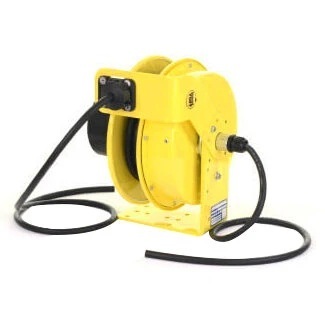
This 15A outdoor cord reel for utility fleet service may suit compatible light-load equipment used at nearby service positions.
- Maximum amperage: 15A
- Cord: 14 AWG, 3-conductor SOOW
- Cord length: 30 feet
- Enclosure rating: NEMA 4X
- Voltage rating: 600 VAC
- Third-party standards: CSA, UL
- Procurement compliance: BABAA compliant
Confirm the connected equipment's current requirements, termination, and operating conditions before specifying this reel.
20 A, 50 ft, NEMA 4X, 3-Conductor: General Fleet Maintenance
Model: RTFH3L-WW-B12K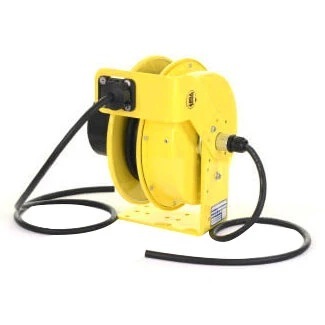
This 20A retractable cord reel for utility fleet maintenance provides 50 feet of reach with a 12 AWG, three-conductor SOOW cord.
- Maximum amperage: 20A
- Cord: 12 AWG, 3-conductor SOOW
- Cord length: 50 feet
- Enclosure rating: NEMA 4X
- Voltage rating: 600 VAC
- Third-party standard listed: CSA, UL
- Procurement compliance: BABAA compliant
The 50-foot reach may suit service positions that need additional access around a truck or work area. Confirm the connected load, required connection, and cord route before selection.
20 A, 30 ft, NEMA 4X, 4-Conductor: Equipment Requiring Four Conductors
Model: RTFC4L-WW-B10G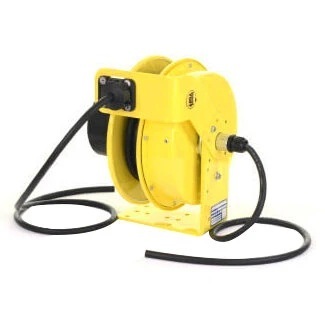
This four-conductor industrial cord reel for utility fleets is worth evaluating when the connected equipment's specification calls for a four-conductor cord.
- Maximum amperage: 20A
- Cord: 10 AWG, 4-conductor SOOW
- Cord length: 30 feet
- Enclosure rating: NEMA 4X
- Voltage rating: 600 VAC
- Third-party standards: CSA, UL
- Procurement compliance: BABAA compliant
Confirm the required conductor arrangement against the equipment documentation. Do not assume that every industrial application requires four conductors.
20 A, 70 ft, NEMA 4X, 3-Conductor: Longer-Reach Fleet Yard Runs
Model: RTFQ3L-WW-B12O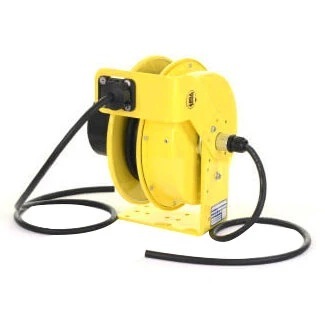
This 70-foot outdoor cord reel for fleet maintenance may suit wider yards or vehicle rows where shorter cords cannot reach the intended connection point.
- Maximum amperage: 20A
- Cord: 12 AWG, 3-conductor SOOW
- Cord length: 70 feet
- Enclosure rating: NEMA 4X
- Voltage rating: 600 VAC
- Third-party standards: CSA, UL
- Procurement compliance: BABAA compliant
Check the electrical requirements and cord routing carefully, especially where the cord could cross vehicle or pedestrian traffic. Confirm current availability before placing a purchase order.
20 A, 100 ft, NEMA 4, 4-Conductor: Long Runs Where NEMA 4 Is Appropriate
Model: RTIL4L-WW-B10U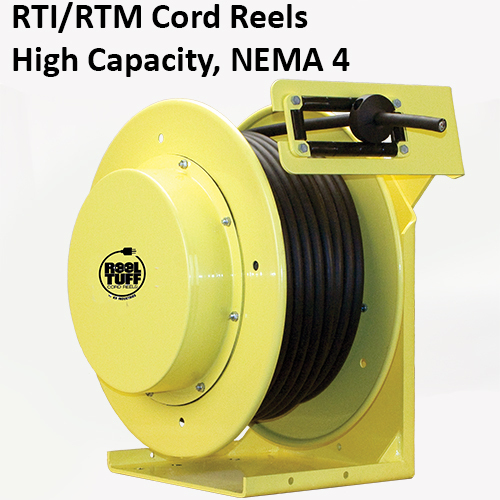
This 100-foot industrial cord reel for utility fleets may suit long runs where NEMA 4 meets the site's requirements. For corrosive environments, evaluate a NEMA 4X-rated alternative instead.
- Maximum amperage: 20A
- Cord: 10 AWG, 4-conductor SOOW
- Cord length: 100 feet
- Enclosure rating: NEMA 4, not NEMA 4X
- Voltage rating: 600 VAC
- Third-party standard: CSA
- Procurement compliance: BABAA compliant
This configuration may be suitable for long runs in a bay or sheltered fleet area when its rating and electrical specifications meet the installation requirements. For a road-salt-exposed yard or another corrosive environment, evaluate a NEMA 4X configuration instead.
When Should You Consider Fleet Cord Reel Power Stations?
Fleet cord reel power stations can be worth considering when several vehicles need access to power in one area. Instead of installing individual reels at every position, a multi-reel station groups retractable reels with electrical outlets on a shared mounting arrangement.
KH Industries' Cord Reel Power Stations offer configurable options for applications such as engine block heater connections, multiple service points, and compatible charging equipment. Depending on the configuration, options can include one to four reels, 3-foot or 6-foot pole heights, different outlet layouts, and cord gauge and length choices. Available reel configurations may include NEMA 4 or NEMA 4X ratings.
Potential applications include:
- Engine block heater connections for parked fleet vehicles
- Multiple service points in a truck yard
- Compatible electric pallet jack or vehicle charging applications
- Sites where several retractable power connections need to be grouped together
The right setup depends on the number of connection points, connected loads, mounting arrangement, electrical supply, outlet layout, and environmental conditions. These are configurable solutions, not one standard model number for every possible combination.
Confirm the station configuration and part number with KH Industries before specifying it. For a closer look at seasonal fleet power needs, read Powering Your Fleet Through Winter: Benefits of Cord Reel Power Stations.
How Do You Select the Right Industrial Cord Reel for a Utility Fleet?
Use these four steps to narrow the options before requesting a quote.
1. Determine the electrical load
Confirm the connected equipment's voltage, amperage, and conductor requirements. Compare them with the reel's rated current, gauge, and conductor count.
2. Measure the required cord reach
Map the mounting point, bay width, vehicle positions, and row spacing. Select a cord length that reaches the connection point without leaving unnecessary cord across traffic routes.
3. Confirm the environment
Assess exposure to rain, dust, road salt, washdown, and corrosive conditions. Evaluate NEMA 4 and NEMA 4X ratings against the actual installation requirements rather than relying on a general indoor/outdoor label.
4. Confirm conductor count and configuration
Select a three or four-conductor model according to the equipment's wiring specification. Verify the cord type, termination, mounting, and applicable product documentation.
Installation also affects access and cord routing. Read KH Industries' guide to industrial cord reel mounting: overhead vs. wall vs. floor mounts when planning the installation location.
For fleet orders or application-specific configurations, share the connected equipment's specifications, required cord reach, environmental exposure, and mounting layout with the KH Industries team. This information helps narrow the available options before a quote is prepared.
Industrial Cord Reels for Utility Fleets: Match the Reel to the Application
The right industrial cord reels for utility fleets combine an appropriate electrical rating, cord construction, working length, enclosure rating, and installation arrangement. A 30-foot reel may suit a compact service position, while a longer reel or multi-reel power station may be worth evaluating for a wider yard. NEMA 4 and NEMA 4X should be distinguished carefully, especially where corrosion exposure is part of the site requirements.
KH Industries offers standard retractable cord reel configurations and modification options for different electrical and installation needs. Compare the available models, verify their specifications against the application, and contact our team when a fleet requires a specific cord length, gauge, connector, or mounting arrangement.
For fleet orders or application-specific requirements, talk to a KH Industries expert or request a quote.
Also, explore our other product lines, including Heavy Duty Industrial Cord Reels and Outdoor Industrial Cord Reels, to compare configurations for other industrial applications.
Reviewed by the KH Industries engineering team, Hamburg, New York.
Frequently Asked Questions
What cord reels are best for utility fleet yards?
The right reel depends on electrical load, cord reach, environmental exposure, and installation. For outdoor locations, evaluate the appropriate NEMA rating and cord construction.
What NEMA rating do I need for an outdoor utility fleet cord reel?
NEMA 4 and NEMA 4X both address enclosure protection, but NEMA 4X adds corrosion resistance. A fleet yard exposed to road salt or corrosive conditions may warrant NEMA 4X. Check the actual exposure and the complete product rating before selection.
What cord length do utility fleet cord reels need?
A 30-foot reel may suit a compact bay, while 50 feet may fit a truck lane. Wider yards or cross-bay runs may require 70 or 100 feet. Measure the intended route and confirm that the cord can reach the connection point without creating unnecessary exposure to vehicle traffic.
Can I use cord reel power stations for engine block heater hookups?
KH Industries identifies its Cord Reel Power Stations for engine block heater applications. The stations can be configured with multiple reels and different mounting and electrical arrangements. Confirm the heater load, supply, outlet configuration, and station specifications before use.
Do industrial cord reels for utility fleets need to be BAA compliant?
For municipal or federally funded purchasing, Buy American Act (BAA) and Build America, Buy America Act (BABAA) requirements may apply, depending on the funding and procurement rules. Check the applicable contract requirements and current product documentation before specifying a model.
What should I check before ordering a heavy-duty cord reel for fleet maintenance?
Confirm amperage, voltage, cord length, AWG, conductor count, cord type, enclosure rating, termination, mounting, and any required procurement compliance. Provide the connected equipment's specifications and intended environment when requesting a quote.


