

Shedding Light on Danger Zones: Your Guide to Explosion Proof and Flameproof Lighting
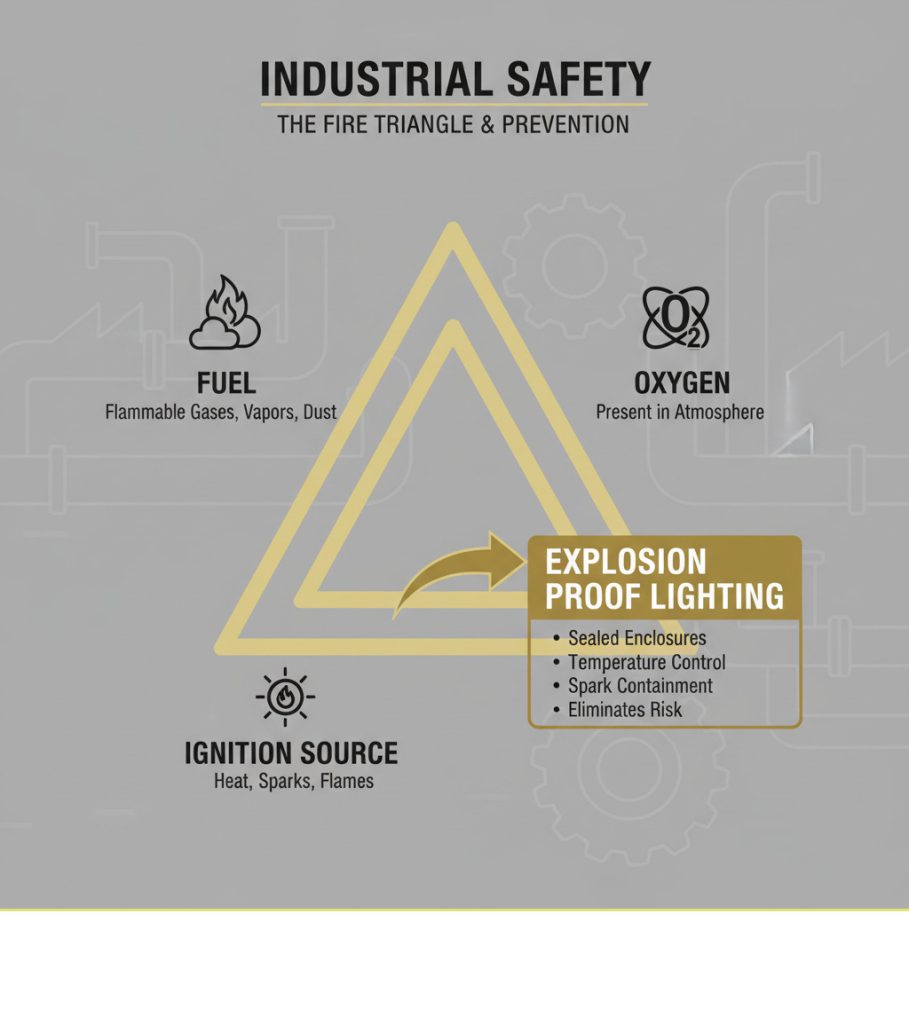
Industrial explosion-proof lighting is specialized illumination designed to operate safely in environments where flammable gases, vapors, combustible dust, or ignitable fibers are present. These fixtures prevent internal sparks or heat from igniting hazardous atmospheres by containing any explosion within a heavy-duty enclosure and cooling escaping gases through engineered flame paths.
Quick Answer: What You Need to Know About Industrial Hazardous Location Lighting
- Purpose: Prevents lighting equipment from becoming an ignition source in hazardous locations
- Where It’s Required: Oil refineries, chemical plants, grain processing facilities, mining operations, paint booths, and any area with explosive atmospheres
- Key Features: Heavy sealed enclosures, certified to contain internal explosions, rated by Class/Division or Zone systems
- Common Ratings: Class I Division 1 (gases/vapors present normally), Class II Division 1 (combustible dust), IP66/IP67 (dust/water protection)
- LED Technology: LED options use 75-90% less energy than traditional HID or incandescent, with long lifespans
In hazardous industrial environments, a stray spark can cause a catastrophic explosion. A single light fixture failure in a facility with flammable vapors or combustible dust is a potential disaster that can cost lives, damage infrastructure, and halt operations.
That’s why proper lighting in these danger zones isn’t optional. It’s a fundamental safety requirement backed by strict regulations like the National Electrical Code (NEC), Canadian Electrical Code (CEC), ATEX, and IECEx standards.
The challenge for safety officers and project managers is to find lighting that performs reliably while eliminating ignition risk. Standard industrial fixtures lack the engineered containment, temperature controls, and certified construction required to prevent explosions.
The good news? Modern industrial hazardous location lighting has evolved dramatically. Today’s LED solutions deliver superior illumination, dramatic energy savings, extended lifespans, and reduced maintenance—all while meeting the most stringent safety certifications for hazardous locations.
Why ‘C1D1’ is a Must-Have, Not a Nice-to-Have
When we talk about industrial C1D1 rated lighting, we’re not discussing an optional upgrade. This equipment can mean the difference between a normal workday and a catastrophic disaster.
In many industrial facilities, the air contains invisible dangers like flammable gases, vapors, or combustible dust. A small electrical fault inside a standard light fixture could trigger an explosion, destroying equipment, harming workers, and shutting down operations.
That’s where explosion-proof lighting earns its name. These fixtures are engineered to contain any internal explosion within their heavy-duty housings. If an electrical spark or arc occurs inside the fixture, the robust enclosure is strong enough to prevent flames and hot gases from escaping into the surrounding hazardous atmosphere.
Containment is only part of the story. These fixtures also feature precisely machined flame paths—gaps that allow escaping gases to cool below the external atmosphere’s ignition temperature. This built-in safety system neutralizes danger before it can spread.
The benefits go beyond preventing explosions. This lighting protects your people, safeguards equipment, and ensures operational continuity, preventing costly shutdowns.
This isn’t about being overly cautious. It’s about being smart, compliant with safety regulations, and responsible. You can explore our full range of certified solutions at More info about HazLoc Lighting.
Primary Applications in Industrial Settings
So where exactly is industrial hazardous location lighting required? These specialized fixtures are critical in more places than most people realize.
Oil and gas refineries handle volatile substances, and every processing unit, storage area, and loading dock needs certified explosion-proof illumination.
Chemical processing plants, handling flammable solvents and reactive gases, require mandated safety lighting.
Paint spray booths create highly ignitable clouds of paint particles and solvent vapors. A standard light fixture is a major risk.
Grain elevators and processing facilities have extremely combustible grain dust, creating explosive conditions similar to flammable gases.
Mining operations, especially coal mines, deal with methane and coal dust. This dangerous combination requires durable, explosion-proof lighting.
Utility excavation work, especially for gas utilities, requires portable hazardous location lighting for crews working near gas lines or leaks.
Marine, shipbuilding, water treatment, and manufacturing facilities handling solvents or fibers also need specialized fixtures to prevent ignition.
If you’re working in any of these industries, you can Learn more about explosion-proof lighting for industrial applications to find solutions that match your specific needs.
The Difference Between Explosion Proof and Hazardous Location Lighting
Understanding this distinction can save you from costly specification mistakes.
While often used interchangeably, “explosion proof” and “hazardous location lighting” are different. All explosion-proof lights are for hazardous locations, but not all hazardous location lights are explosion-proof.
Explosion proof is a specific design where a robust enclosure contains any internal explosion. If a spark occurs, the housing contains the blast, and machined flame paths cool escaping hot gases before they reach the outside air. These are typically rated for Class I, Division 1 environments, where flammable gases are present during normal operations.
Hazardous location (HazLoc) lighting is the broader category of certified equipment for areas with explosive atmospheres. It includes explosion-proof fixtures as well as other protection methods like purged/pressurized systems, intrinsically safe designs (limiting energy), and non-incendive equipment.
The practical difference is the safety strategy. Explosion-proof lighting uses containment. Other HazLoc lights prevent ignition by keeping hazards out, limiting energy, or controlling temperature.
Not all hazardous locations require explosion-proof fixtures, but the most dangerous ones absolutely do. Understanding which type you need requires knowing your specific environment’s classification. We’ve put together helpful resources like Shedding Light on Safety: Understanding Hazardous Location Lighting Regulations to help you steer these decisions with confidence.
Decoding the Ratings: Your Guide to Certifications
Choosing the right industrial explosion-proof or hazardous location lighting requires ensuring it has the proper certifications for your workplace. These are legal requirements that determine if a light can operate safely in a hazardous area.
The standards can seem overwhelming. North America uses the National Electrical Code (NEC) and Canadian Electrical Code (CEC). Internationally, you’ll encounter ATEX (EU) and IECEx (global). These frameworks exist to keep workers and facilities safe.
Our products are tested against these demanding requirements, ensuring compliance with NEC, CEC, IECEx, and ATEX standards. Matching the right ratings to your environment is critical. A fixture certified for one hazard may not protect against another, creating a serious safety risk. To see how these certifications apply across our product line, explore our understanding explosion-proof standards resources.
The North American System: Class, Division, and Group
The US and Canada use a three-part system: Class, Division, and Group. This system identifies the type of hazardous material (Class), how often it’s present (Division), and its specific properties (Group).
Class identifies the hazard’s nature: Class I for flammable gases/vapors, Class II for combustible dusts, and Class III for ignitable fibers.
Division describes hazard frequency. Division 1 means ignitable concentrations exist normally or frequently during maintenance. Division 2 means they are not likely during normal operations but could occur briefly in abnormal situations.
| Classification | Description of Hazard Type | Conditions of Presence |
|---|---|---|
| Class I | Flammable gases, vapors, or liquids | Division 1: Ignitable concentrations exist under normal operating conditions, or frequently due to maintenance/breakdown. Division 2: Ignitable concentrations are not likely to exist under normal operating conditions, but may exist for short periods due to abnormal operations or equipment failure. |
| Class II | Combustible dusts | Division 1: Ignitable concentrations exist under normal operating conditions, or frequently due to maintenance/breakdown. Division 2: Ignitable concentrations are not likely to exist under normal operating conditions, but may exist for short periods due to abnormal operations or equipment failure. |
| Class III | Ignitable fibers or flyings | Division 1: Ignitable concentrations exist under normal operating conditions, or frequently due to maintenance/breakdown. Division 2: Ignitable concentrations are not likely to exist under normal operating conditions, but may exist for short periods due to abnormal operations or equipment failure. |
Group specifies the substance. For Class I (gases), Groups range from A (acetylene) to D (propane, gasoline). For Class II (dusts), Groups include E (metal dusts), F (coal dust), and G (grain dust).
Understanding these classifications ensures that our industrial C1D1 hazardous location lighting fixtures aren’t just built tough—they’re specifically engineered to handle the exact hazards in your facility.
The International System: Zones
Much of the world uses the Zone system (IECEx and ATEX standards), which focuses on the frequency and duration of an explosive atmosphere.
For gases/vapors, Zone 0 means a continuous hazard, Zone 1 means an occasional hazard during normal operation, and Zone 2 means a hazard is unlikely. For dusts, the classifications are Zone 20, Zone 21, and Zone 22, respectively.
Beyond these zone classifications, two additional ratings provide crucial protection details. IP Ratings (Ingress Protection) indicate resistance to solids (first digit) and liquids (second digit). An IP66 rating means a fixture is dust-tight and protected from powerful water jets. IP67 adds protection against temporary immersion. This is crucial, as dust or water ingress can compromise safety.
The T-Rating (Temperature Code) indicates the maximum surface temperature a fixture can reach, which is critical to prevent igniting the surrounding atmosphere. A lower T-number corresponds to a higher temperature (e.g., T1 = 450°C), while a higher T-number means a cooler surface (e.g., T4 = 135°C).
These international standards might seem complex, but they serve the same purpose as North American classifications: ensuring your lighting doesn’t become an ignition source. Whether you’re working with NEC codes or ATEX directives, the goal remains constant—keeping people safe in dangerous environments.
Selecting the Right Industrial Hazardous Location Lighting Fixture
After understanding hazardous location and explosion proof classifications, you must choose the right fixtures to keep your facility safe and productive. There is no universal solution; different environments require different types of industrial explosion proof lighting.
Our portfolio covers all industrial lighting needs while meeting top safety standards. High bay fixtures illuminate large spaces with high ceilings. Linear fixtures are ideal for general area and task lighting, replacing traditional fluorescent tubes. Floodlights deliver powerful beams for outdoor areas and large equipment. For temporary work in tight spots, portable solutions like our HazRay Single LED Handheld offer flexibility. For tunnels or trenches, our HazRay LED Stringer provides distributed temporary lighting.
Key Factors Influencing Your Choice
Picking the right fixture type and matching it to your hazardous area rating is just the beginning. Several other critical factors determine whether your industrial explosion proof lighting will truly meet your operational needs.
Lumen output is the amount of visible light. Match output to your space and task to avoid safety hazards from too little light or glare from too much.
Correlated color temperature (CCT), measured in Kelvin, describes the light’s appearance from warm to cool. Cooler temperatures (e.g., 5,000K) can improve visibility and alertness in industrial settings.
Color Rendering Index (CRI) measures how accurately light shows true colors. A CRI of 70+ is critical for tasks like identifying color-coded wires or inspecting products.
Ambient temperature ratings are crucial for extreme heat or cold. Our fixtures are engineered for reliability in wide temperature ranges, from -40°C to 65°C (149°F). Our HazRay series is built for tough conditions.
Beam angle and distribution determine how light spreads. Proper selection ensures light is directed where needed, eliminating shadows and waste.
The Advantages of Modern LED Technology
If you’re still running traditional HID or incandescent bulbs in your hazardous locations, you’re leaving serious benefits on the table. Modern LED technology hasn’t just improved industrial explosion proof lighting—it’s completely transformed it.
Energy savings are remarkable: LEDs use up to 75% less energy than HID and 90% less than incandescent systems. This directly lowers utility bills and reduces your environmental footprint.
Longevity is a key advantage. Our LEDs last up to 100,000 hours, meaning less downtime and maintenance. In hazardous locations, where fixture access is difficult, this extended life is transformative.
Reduced maintenance is a direct result of longevity. Fewer bulb changes mean less production interruption and allow maintenance teams to focus on more critical tasks.
Durability is inherent to LEDs. As solid-state devices, they resist shock, vibration, and corrosion common in industrial settings.
Lower heat output provides an additional layer of safety. LEDs are more efficient and run cooler than traditional bulbs, which is paramount for controlling ignition sources.
Instant-on illumination at full brightness is another benefit. Unlike HIDs that need warm-up time, LEDs are immediately responsive, which is critical in emergencies.
These combined advantages create a compelling case for LED technology in any hazardous environment. For a comprehensive look at how LED innovation is reshaping industrial safety, explore our article on Illuminating Safety in Hazardous Industries with HazRay Lighting Solutions.
Maintenance, Upgrades, and the Future of Safe Lighting
The best industrial hazardous location lighting is the kind you can install and forget, as it works reliably for years without constant attention or repairs.
Modern LED fixtures have changed the maintenance game. With lifespans over 100,000 hours (and years of continuous use), they are built to endure. Most facilities see a payback in just a few years. Less maintenance also means fewer entries into hazardous areas, a significant safety benefit.
When needed, maintenance is simple: routine cleaning to prevent buildup on lenses and infrequent inspections of seals and wiring. This is minimal work compared to older systems.
If you use legacy HID or incandescent fixtures, consider an LED upgrade. Benefits include energy savings (up to 90%), better light quality, instant-on capability, and long life. Ensure new fixtures match your area’s Class, Division, and Group ratings. Retrofit adapters can simplify the upgrade process. To explore how our solutions can transform your facility’s lighting, check out More about our lighting solutions.
Advanced Features for Your Industrial Hazardous Location Lighting
The future of safe lighting in hazardous environments isn’t just about brighter bulbs—it’s about smarter systems that work harder for you. Today’s industrial explosion proof lighting can do far more than simply illuminate a space.
Smart controls allow for centralized adjustment of light levels and schedules, optimizing energy use by adapting to operational needs.
Integration with factory automation connects lighting with building management or industrial control systems for automated adjustments during shift changes or emergencies.
Occupancy sensors save energy by automatically turning lights on when a space is entered and dimming or turning them off when it’s empty.
Daylight harvesting uses sensors to detect natural light, automatically dimming fixtures to save energy while maintaining consistent illumination.
Remote monitoring and diagnostics provide real-time data on performance and energy use, enabling proactive maintenance to reduce downtime.
These intelligent features don’t just make your lighting more efficient—they make your entire operation safer and more responsive. And when it comes to delivering reliable power to these advanced systems in hazardous locations, our KH Industries Cord Reels: Industrial Use, Hazardous Locations provide the robust, certified solutions you need to keep everything running smoothly.
Conclusion: Prioritizing Safety with the Right Illumination
We’ve covered a lot of ground here, and if there’s one thing we hope you take away, it’s this: when you’re working in environments where the air itself can become a danger, industrial explosion proof lighting isn’t something you compromise on. It’s the foundation of a safe workplace.
Throughout this guide, we’ve explored why specialized lighting is essential in hazardous locations—from oil refineries and chemical plants to grain elevators and mining operations. We’ve clarified the important distinction between explosion-proof fixtures (designed to contain internal explosions) and the broader category of hazardous location lighting. Understanding these differences matters because the wrong fixture in the wrong place isn’t just a compliance issue; it’s a genuine safety risk.
We’ve also walked through the certification systems that govern these products. Whether it’s the North American Class/Division/Group system or the international Zone classifications, proper certification isn’t bureaucratic red tape—it’s your assurance that a fixture can handle the specific hazards in your facility. Those IP ratings for dust and water protection, those T-ratings for temperature limits—they’re all there to keep your people safe.
The shift to modern LED technology has been a game-changer for facilities across the United States and Canada. When you can reduce energy consumption by up to 90%, extend fixture life to 100,000 hours, and virtually eliminate maintenance in hard-to-reach hazardous areas, the benefits go far beyond just saving money. You’re creating a safer, more reliable work environment. Add in features like instant-on illumination, lower heat output, and resistance to shock and vibration, and the advantages become even clearer.
At KH Industries, we understand that safety is never negotiable. That’s why we’re committed to providing durable, certified, and reliable lighting solutions specifically engineered for the most challenging industrial environments. We’ve spent years perfecting our products because we know what’s at stake—your team’s safety, your facility’s integrity, and your operation’s continuity.
If you’re ready to upgrade your hazardous location lighting or simply want to explore what’s possible with modern industrial explosion proof lighting, we’re here to help. For durable and certified illumination solutions, explore our complete range of Explosion Proof Lighting. Your safety is our priority, and we’re confident we can provide the right solution for your specific needs.