


Temporary Power for POP Retail Interactive Retail Displays
Last updated on May 23rd, 2025 at 09:44 am
Creating eye catching point of purchase displays that enhance your own or your vendors brand is what drives retail impulse sales. When these displays are interactive or have electrical elements that require temporary power, more planning is required to determine what the options and best choices to electrify your temporary retail displays.
Often, the options are limited because of local electrical ordinances and OSHA compliance issues. Some considerations that will drive the decision on temporary power choices are:
What are the electrical requirements?
- Maximum amperage draw is?
- How many receptacles will be needed?
- Is GFCI protection required?
- Will the electrical be temporary and tap into an existing receptacle, or will it be hard wired into a junction box?
- Where will the original power source come from? The ceiling, floor, wall, what is the distance the power feed cord will need to reach from the power source to the display?
- Does it need to blend into the environment for aesthetic purposes or to comply with corporate interior space and brand guidelines?
Let’s explore each of these questions and see how it can affect the overall decision of what is the best temporary power solution for your POP retail display.
Maximum Amperage Draw
All electrical devices use voltage and current for the operation of that device. The product of these two distinctly different electrical characteristics is watts. The mathematical formula for this product is volts (v) times amperes (i) is equal to watts (w) or (v * i = w). Applying algebra to this formula for finding amperage is equal to watts divided by voltage or (i = w / v).
For example, if you are designing a Doggie Ice Cream Display and the freezer draws 115 volts and 736 Watts the amperage draw is 6.4 (736/115 = 6.4 amps).
How many receptacles will be needed?
The answer to this depends on how many powered elements are in your display. For our Doggie Ice Cream Display we only need to power the freezer and one receptacle is adequate. In a temporary POS display, you may require additional outlets for cash register, credit card payments, lighting, etc.
Is Ground-Fault Circuit Interrupters (GFCI) required?
The National Electric Code (NEC) has expanded the requirements for GFCI to protect anyone who plugs into an electrical system. Initially, it was only required for temporary wiring at construction sites and in dwelling unit bathrooms, but in recent years the Code requirements for GFCI protection have expanded to include many other areas, including commercial occupancies, fountains and swimming pools, and temporary installations, to name a few. For the purposes of this article, Temporary Installations are the most common scenario, here is what the NEC sites as a requirement:
Temporary installations
- In accordance with 527.6(A) and (B), you should always install GFCI devices on temporary wiring systems to protect workers during construction, remodeling, maintenance, repair, or demolition of buildings, structures, equipment or similar activities. All 15A, 20A, and 30A, 125V receptacle outlets that are not a part of the permanent wiring of the building or structure shall be equipped with GFCI protection. If a 15A, 20A, or 30A, 125V receptacle is part of the permanent wiring of the building or structure and it is used for temporary electric power, GFCI protection for workers must be provided.
- There is an exception to this rule. In industrial establishments where conditions of maintenance and supervision ensure that only qualified personnel are involved, an assured equipment grounding conductor program as specified in 527.6(B)(2) is permitted for only those receptacle outlets used to supply equipment that would create a greater hazard if power was interrupted or those that have a design that is not compatible with GFCI protection.
Will the electrical tap into an existing receptacle or will it be hard wired into a junction box?
- For most temporary POP powered displays, you’ll want to use an existing receptacle. Depending on your power/amperage requirements you’ll need a N5-15R or N5-20R on the feeder end.
Where will the original power source come from, the ceiling, floor, or wall? What is the distance the power feed cord will need to reach from the power source to the display?
- This is important to know, most feeder cords on economy, light duty service reels come in a standard 18” length. For industrial cord reels and power pendent bus drops, these lengths can usually be customized for your application.
Does it need to blend into the environment for aesthetic purposes or to comply with corporate interior space and brand guidelines?
- Many retail establishments do not want the power source to be visible. If the power is coming from the floor or a receptacle on a column, it may be hidden by the display. But in many cases, the power is dropped from a receptacle box at the ceiling. In the case of Walmart/Sam’s Clubs they have interior space guidelines that anything ceiling mounted needs to be white to blend into their existing décor. Many retailers have similar policies, because a bright safety yellow or red cord reel will call attention away from the POP. This has led to an increase in demand for white cord reels from this market share.
Now that we’ve gone over the electrical and environmental considerations, let’s talk about options for temporary power.
Options for Temporary Power
Light Duty, Economy Cord Reels
 The easiest and least expensive option if an off-the-shelf product will meet your needs and you require 10 amps or less. Most come with an 18” power feeder cable and a standard N5-15P for easy plug and play operation. Also available with a triple tap N5-15R and reset circuit breaker. Follow the lead of the big box leaders such as Dicks Sporting Goods, Walmart, Sam’s Club and many others, and go with a white colored reel with white cable so nothing detracts from your POP display.
Heavy Duty Retractable Cord Reels
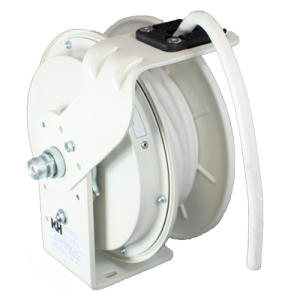 More costly, but required when for 20 amp or higher service. These reels can be built for indoor or outdoor use, including wet locations and have customized options for feeder20amp-white-retractable-power-cord-reel cable length, reel and cable colors, and power accessories such as receptacles and outlet boxes. You’ll find Heavy Duty Retractable Cord Reels for more intense retail self service areas such as frozen food departments, or POP and POS displays that require power for several features, ie: refrigeration, lighting, and cash out transitions.
Power Pendant Outlet Boxes
 If there isn’t a need to retract the cable back into a reel, consider a Power Pendant Outlet Box. Bus drops (as they are known in the electrical industry), are a low cost solution to delivery power from high ceilings to a POP displays. The can be customized by amperage, cord length, cord color and power accessories such as receptacles or outlet boxes. Power Pendant Outlet Boxes are commonly used in industrial facilities for a semi-permanent tangle free power solution.
Power Stringers
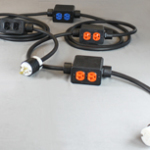 Power stringers are most commonly used in convention and event facilities where multiple power outlets are required and sometimes on different circuits. This would be the least applicable solution to POP Displays, but in the event of a multi-vendor event power stringers allow you to customize amperage, cord length between outlet boxes, and color (typically black or yellow boxes).
With all temporary power solutions, local electrical codes and OSHA standards need to be followed to avoid electrical hazards.
For more information, contact your KH Industries temporary power sales specialist.